AI SDR Software, If It Solves Deliverability and Context
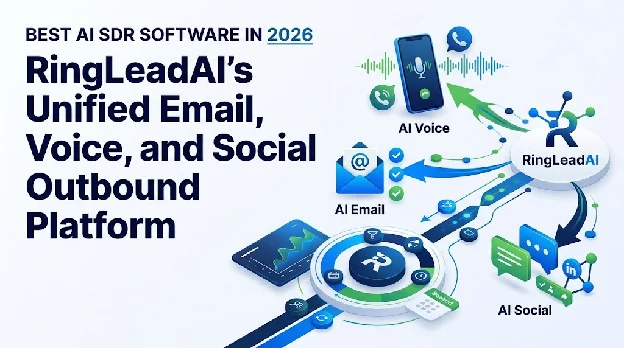
AI Sales Development Representative (AI SDR) software changes the economics of pipeline generation — provided it solves the deliverability and context problem.
In 2026, raw volume is no longer an advantage. Google and Yahoo spam thresholds penalize spray-and-pray email blasts, prospects hang up on slow, robotic voice bots, and LinkedIn accounts get restricted for unthrottled automation. Without coordinated timing and cross-channel context, automation simply scales noise.
RingLeadAI consolidates cold email infrastructure, AI voice calling, and social touchpoints into one workspace.
Instead of juggling fragmented subscriptions — a database vendor, a cold email sequencer, a dialer, and a separate social tool — RevOps teams run coordinated, multi-touch plays through a single workflow engine:
- A lead who has not replied to the email gets a call from an AI voice agent.
- Social posts keep you visible between emails and calls.
- Replies, call outcomes, and booked meetings sync back to your CRM.
The objective is not to pump more vanity activity into the market. It is to book consistently qualified, high-intent discovery calls.
This evaluation guide breaks down the multi-channel AI SDR architecture, compares RingLeadAI with single-channel tools, and provides a framework to measure ROI in your first 30 days.
What Is an AI SDR and Where Does It Fit in Modern RevOps?
Understanding what an AI SDR actually is — and where its operational boundaries lie — is critical to preventing costly software mis-hires.
Many tools market themselves as "AI SDRs" when they are merely legacy sequencers with a generative AI copy wrapper. A true AI SDR functions as a multi-channel orchestration engine that initiates outbound conversations, evaluates prospect intent, adapts across channels, and drives qualified discovery meetings into your Account Executives' calendars.
AI SDR vs. Legacy Automation vs. Inbound Chatbots
The outbound tech stack has evolved through three distinct generations:
| Capability Dimension | Traditional Email Sequencers | Inbound Chatbots (e.g., Drift / Intercom) | AI SDR (RingLeadAI) |
|---|---|---|---|
| Outbound Initiation | Static, scheduled drip sequences | None (100% reactive to site visitors) | Multi-touch outreach across email, voice, and social |
| Channel Agility | Siloed to email only | Siloed to the website widget | Coordinated across three channels in one workflow |
| Response Reasoning | Rigid "If-Else" rules; stops on reply | Pre-programmed decision trees | LLM reasoning; dynamic objection handling on calls |
| Voice Capability | None | None | AI phone calling with live transfer to your team |
| Meeting Booking | Sends static scheduling links | Basic calendar widget popups | Books on your calendar during the call and syncs to your CRM |
Traditional dialers accelerate manual calls, and email tools blast scheduled text. RingLeadAI's unified architecture works as a feedback loop: a reply on one channel stops the others, and the workflow decides the next touch.
The Operational Fit: Top-of-Funnel Filtering vs. Human Relationship Building
An AI SDR is not built to close six-figure enterprise contracts or navigate complex multi-stakeholder buying committees. Its objective is to absorb the low-conversion, high-friction top of the funnel:
- Account research: Enriching leads with contact and company data before a single word is sent.
- Persistent multi-touch execution: Running coordinated touchpoints across email, voice, and social without rep fatigue or calendar lapses.
- Qualification: AI voice agents ask your qualifying questions on every call, and replies are classified, so unqualified leads don't reach your reps.
- Frictionless handoff: Warm-transferring a live call to a rep, or booking the discovery slot, the moment buying intent is signaled.
Channel-by-Channel Technical Breakdown
RingLeadAI connects three outbound channels — Email, Conversational Voice, and Social — into one revenue engine. When a prospect replies on one channel, the others stop.
1. Cold Email Sequences: Infrastructure & Deliverability Governance
High-performing outbound email in 2026 demands strict domain isolation and deliverability hygiene. Blasting unvetted cold lists from your primary domain burns your domain reputation and lands critical customer emails in the spam folder.
Deliverability infrastructure
- Secondary domains: Send from isolated sending domains; RingLeadAI checks their SPF, DKIM, and DMARC records (aim for a p=quarantine or p=reject policy).
- Automated inbox warming: Gradual pool warmup that mirrors human sending cadence across Google Workspace and Microsoft 365 inboxes.
- Placement tracking: Warmup measures inbox placement and keeps a reputation score per mailbox; keep complaint rates well below Google's 0.3% threshold.
- Email verification: Invalid addresses are caught before queueing — with Lead Finder or your own ZeroBounce or NeverBounce key.
Dynamic copy
- Relevant first lines: AI drafting plus custom variables carry a specific reason for each lead — recent funding, an executive hire, a technology change — without robotic fluff.
- Reply classification: Incoming replies are classified — Interested, Wrong contact, Objection, Unsubscribe, and more — and a reply stops the lead's outbound cadence.
2. AI Voice Agents: Natural Calling & Live Transfers
Set up AI voice agents for each stage of top-of-funnel outbound — outbound agents that make calls and inbound agents that answer them:
- Speed-to-lead: Call new leads quickly to answer initial questions and book discovery calls.
- Cold outbound qualification: Qualify decision-makers on cold target accounts with your objection handling.
- Follow-up and reactivation: Re-engage stalled CRM leads and past evaluations.
Core voice capabilities
- Natural interruptions: The agent yields when the prospect speaks instead of talking over them.
- Knowledge and scripts: Agents answer from the documents in their knowledge base and follow the prompt you write — or have Rynn write it for you.
- Live transfer: Blind or warm transfer to a person on your team; a warm transfer briefs them before connecting.
3. Social Touchpoints & Unified Inbox
Outbound phone calls and cold emails land better when backed by visible social activity.
- Social touchpoints: Schedule LinkedIn, Facebook, Instagram, and X posts, and add a Post to Social step to any workflow.
- Coordinated cadence: A workflow can wait, check whether the lead replied, and then call, post, or follow up by email.
- Unified inbox: Email replies arrive classified in one inbox; call recordings, transcripts, and outcomes live in the Call Library. Reps see the history and act from one place.
The Unified Architecture Advantage
Standalone point solutions create operational blind spots:
| Disconnected Legacy Stack (Dialer + Sequencer + Social Tool) | RingLeadAI Unified Architecture |
|---|---|
| Data silos: a prospect receives a cold call 10 minutes after asking to be unsubscribed via email. | Shared state: a reply on one channel stops the others, and an opt-out suppresses the lead everywhere. |
| Inflated SaaS overhead: 3 to 5 separate licenses. | One subscription, one workspace, one API. |
| Fragmented reporting: RevOps manually stitches CSVs together to understand attribution. | One view of email, voice, and social activity. |
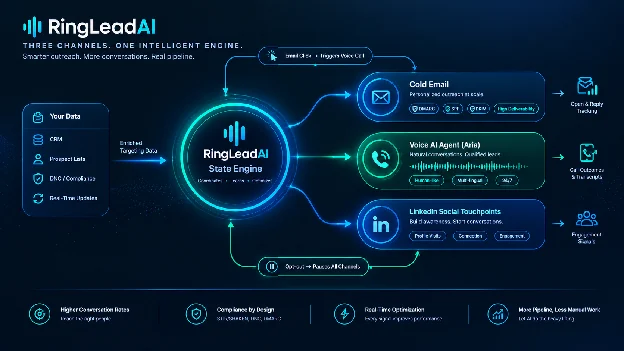
How It Works: The Multi-Touch Sequence Engine
Modern B2B buyers do not convert on single-channel spam. RingLeadAI replaces disconnected cadence tools with one workflow engine that chooses the next touch based on how the prospect responds.
The Dynamic Orchestration Engine
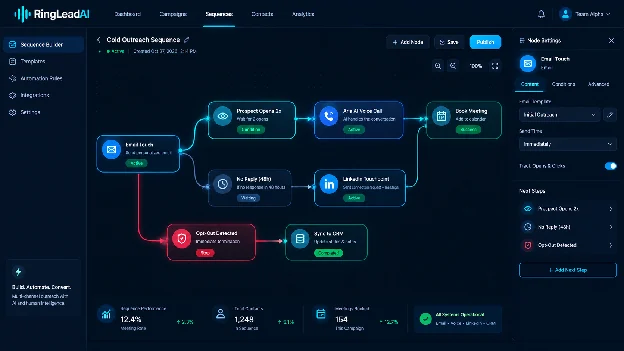
Instead of running rigid linear schedules, a RingLeadAI workflow executes conditional logic across email, voice, and social channels:
Example workflow
- Remaining follow-ups stop on every channel.
- The reply is classified (Interested, Meeting requested) and surfaces first in the inbox.
- Slack alert to the rep; lead status updated.
- An AI voice agent calls the lead.
- Interested on the call? It books the meeting on your calendar or warm-transfers to a rep.
- Otherwise: a social post and an alternate-angle follow-up email.
- “Already working with a vendor” is classified as an Objection.
- The sequence stops across all channels.
- Your SDR answers — or edits the AI's suggested reply — or routes it to an AE.
Reply Classification & Guardrails
Automated outbound fails when systems misinterpret prospect sentiment. RingLeadAI classifies every inbound reply, so each kind gets the right next step:
- High intent / positive: ("Sounds interesting, send over some times.")
- What happens: Follow-ups stop, the reply surfaces first in the inbox, and your rep books the meeting — or the AI voice agent books it on a call.
- Information request / question: ("Can you share case studies on healthcare integrations?")
- What happens: The AI drafts a reply; anything it is not confident about is held for your SDR to review and send.
- Out of office: ("I am away until next Tuesday with limited access.")
- What happens: Labelled Out of office, so it never reads as a real reply in your numbers.
- Opt-outs: ("Remove me from your list" / "Not interested at this time.")
- What happens: Unsubscribes are suppressed across email, voice, and social, eliminating the risk of follow-up violations.
The 6-Step Production Deployment Playbook
To validate pipeline impact without risking domain health or brand reputation, run deployments through a disciplined six-stage framework:
CRM & availability hookup
Connect Salesforce, HubSpot, Pipedrive, or Close, and your Cal.com calendar. Set buffers, minimum notice, and routing in Cal.com before dialing a single record.
Cohort curation & contact validation
Isolate a tight pilot cohort of 200–500 ideal customer profile (ICP) accounts. Verify emails, and confirm phone numbers comply with applicable consent and line-type rules.
Sending infrastructure & domain isolation
Send from secondary domains with SPF, DKIM, and DMARC in place. Warm the inboxes up, and watch Google Postmaster Tools to keep spam complaints below 0.1%.
Multi-touch sequence engineering
Map the interaction architecture: initial email value-hooks, your AI voice agent's prompt and objection handling, and social touches.
End-to-end testing
Talk to your agent in the browser before launch, and check calendar booking, opt-out suppression, and CRM sync on test leads.
Live rollout & benchmarking
Launch and track positive conversation rate (qualified interactions relative to total touches) and cost per booked appointment against your human SDR baseline.
Unified Ecosystem Integrations: CRM, Calendars, Inboxes & Webhooks
An AI SDR cannot operate in isolation. If outbound activity fails to sync with your core database, sales reps waste hours cross-referencing records, and data integrity collapses.
RingLeadAI connects to your revenue infrastructure through OAuth CRM connections and real-time webhooks.
CRM Synchronization: Salesforce, HubSpot, Pipedrive & Close
- HubSpot: Native CRM sync — contacts and activity flow into HubSpot.
- Salesforce: Leads pushed as Salesforce Leads; replies and call outcomes land as Tasks.
- Pipedrive and Close: People, activities, replies, and call outcomes stay in sync.
Inboxes & Calendar Booking
- Inboxes: Connect Gmail / Google Workspace and Outlook / Microsoft 365 inboxes — or any SMTP/IMAP provider — for sending and reply detection.
- Calendar booking: AI voice agents check availability and book through your Cal.com account, which sits on top of your Google or Outlook calendar, so meetings never double-book.
- Show-rate protection: Calendar invites and reminders go out from Cal.com the moment a meeting is booked.
Webhooks & Custom RevOps Workflows
For teams using custom internal databases, data warehouses (Snowflake, BigQuery), or automation hubs (Zapier, Make), RingLeadAI sends events out as they happen:
- HMAC-signed webhooks: Signed outbound events for every key action in your workflows, verifiable on your side.
- Zapier and REST API: Connect 5,000+ apps without code, or build custom integrations on the full API.
Unit Economics & Total Cost of Ownership
Evaluating an AI SDR platform requires examining the fully-loaded cost of running outbound development — not merely comparing software license fees against a rep's base salary.
| Operational Expense Category | In-House Human SDR (Single Rep) | AI SDR (RingLeadAI) |
|---|---|---|
| Compensation | Base salary, OTE, benefits, and taxes | Platform subscription and usage |
| Tech stack | Separate dialer, sequencer, and data seats | Email, voice, and social in one platform |
| Recruitment & ramp | Months of hiring and onboarding | Live once inboxes are warmed and agents tested |
| Daily call & email volume | Limited by working hours | Runs in parallel, within your sending limits |
| Turnover risk | High | None |
An AI SDR absorbs the repetitive, top-of-funnel friction — so existing Account Executives and senior reps can focus their bandwidth on closing deals, multi-threading accounts, and driving expansion.
7-Day Risk-Free Evaluation
To validate unit economics inside your own business without a long-term commitment:
- 7-day full access trial: Test AI voice calls, email warmup, and calendar booking end to end.
- No credit card required: Run initial cohort testing with zero upfront commitment.
- Clear plans: see the pricing page for email, voice, and suite plans.
RingLeadAI vs. Apollo, Outreach, and Instantly
Choosing the right outbound platform depends on your sales development architecture. Some tools specialize in lead enrichment and database intelligence; others manage enterprise rep workflows or scale cold email infrastructure.
RingLeadAI is built as a multi-channel AI SDR, unifying cold email, conversational voice agents, and social outreach in one workspace.
Where RingLeadAI Delivers Differentiated Value
1. Coordinated multi-channel workflows (not fragmented silos)
Many sales stacks stitch together one tool for data, another for cold email, and a manual dialer for reps. RingLeadAI runs all three touchpoints in one workflow:
- A lead who has not replied gets an automated AI voice call.
- Social posts keep you visible between touches.
- An opt-out on any single channel stops activity across all three, protecting domain reputation and regulatory compliance.
2. AI voice with live handoffs
Unlike legacy dialers that simply connect calls to human reps, RingLeadAI's voice agents carry two-way qualification conversations:
- Handle objections using the guardrails in your prompt.
- Ask your qualifying questions on every call.
- Warm-transfer to a human Account Executive when buying intent is clear.
3. Continuous deliverability governance
High-volume cold outreach fails without deliverability safeguards. RingLeadAI checks SPF, DKIM, and DMARC, warms every inbox up with placement tracking, enforces per-inbox daily limits, and pauses campaigns automatically when bounces spike.
Which Platform Best Aligns With Your Revenue Model?
- Choose Apollo.io if you prospect internationally or need a database of hundreds of millions of records, and you have a team of human SDRs to work the lists. RingLeadAI includes five million US contacts and runs the outbound itself (RingLeadAI vs Apollo).
- Choose Outreach.io if you are an enterprise organization with 25+ human sales reps who need complex pipeline inspection, Salesforce governance, and multi-layered management reporting (RingLeadAI vs Outreach).
- Choose Instantly.ai if your strategy relies strictly on high volumes of cold email across many secondary inboxes without voice or phone outreach (RingLeadAI vs Instantly).
- Choose RingLeadAI if you want to eliminate manual dialing and low-conversion rep churn with an AI SDR that orchestrates cold email, natural phone conversations, and social touches into confirmed, qualified meetings.
Trusted by Modern Revenue Teams






Your First 7 Days: Onboarding & Evaluation Roadmap
A 7-day trial is not about browsing dashboards; it is designed to systematically validate your deliverability, voice quality, and unit economics before scaling volume.
| Day | Focus Area | Operational Objective | Verification Milestone |
|---|---|---|---|
| Day 1 | CRM & calendar hookup | Connect Salesforce, HubSpot, Pipedrive, or Close; connect Cal.com. | Confirm availability and invite delivery on a test booking. |
| Day 2 | Deliverability & warmup | Connect secondary-domain inboxes; check SPF, DKIM, and DMARC; start warmup. | DNS checks pass; warmup is running for every inbox. |
| Day 3 | Voice agent & talk track | Create your agent; write its qualifying questions and objection guardrails. | Run live test calls in the browser. |
| Day 4 | Controlled pilot launch | Upload a validated cohort of 200–500 ICP records; launch the multi-touch workflow. | Monitor sends, bounces, and early replies. |
| Day 5 | Reply classification | Review replies classified as Interested, Out of office, Objection, or Unsubscribe. | Confirm opt-outs are suppressed; refine your value hooks. |
| Day 6 | Multi-channel sync | Let the workflow call non-repliers and add social touches. | Test a warm transfer and a booked meeting. |
| Day 7 | ROI review | Audit positive reply rate, connect rate, show rate, and cost per booked meeting. | Compare against your human SDR baseline. |