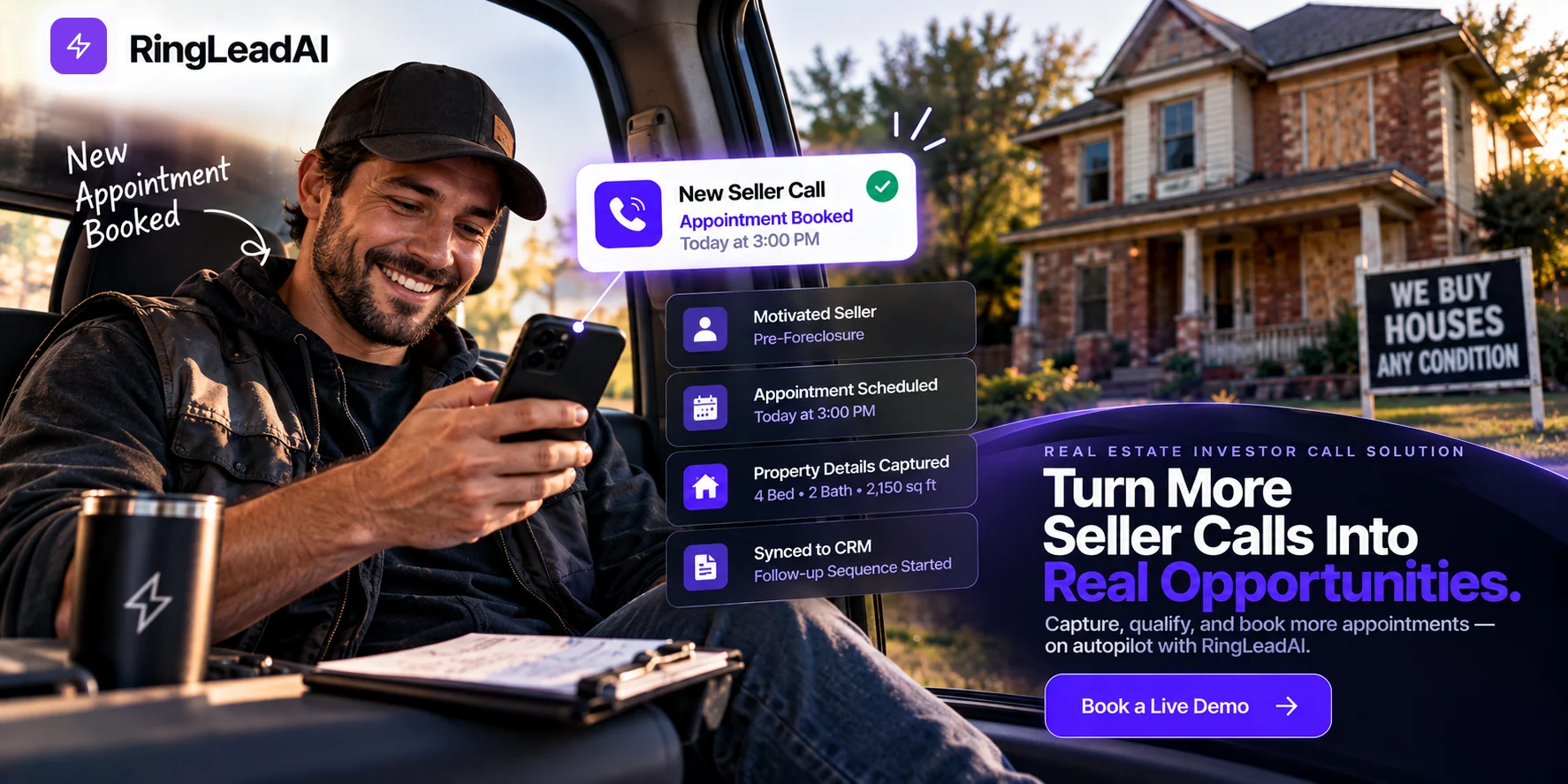
The Problem: Your Marketing Spend Is Buying Your Competitor's Deals
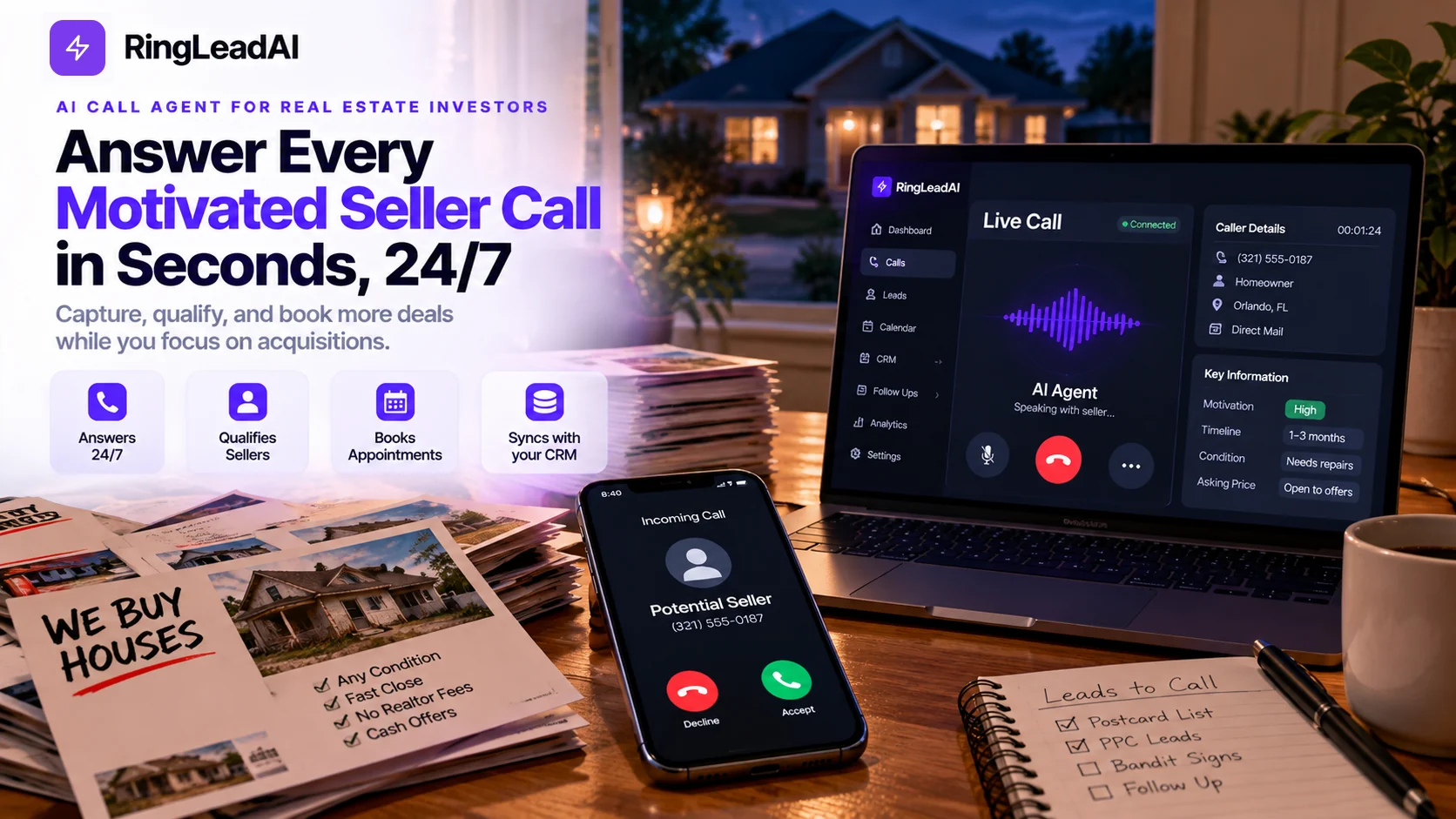
It is 8:40 p.m. A seller calls off your postcard. You are walking a rehab. The call rolls to voicemail.
They do not leave a message. They dial the next postcard on the kitchen counter.
Your $1.20 mailer just bought your competitor a $10,000 assignment fee.
Voicemail is where marketing budgets go to die. RingLeadAI answers the call, screens the lead against your buy box, draws out the equity and timeline, and books the acquisitions appointment on your calendar — 24/7/365.
Core Capabilities at a Glance
- 24/7 inbound capture: every call from direct mail, PPC, bandit signs, or radio ads gets answered — nights, weekends, and while you're on a walkthrough.
- Acquisitions-specific qualification: filters retail price expectations and dead ends before they reach your desk.
- Calendar booking: books qualified sellers onto your acquisitions calendar through Cal.com while they're on the line.
- Live warm transfers: puts your acquisitions desk on the line the moment a seller mentions an auction date, a sub-14-day timeline, or deep equity.
- Opted-in follow-up: follow-up calls to sellers who gave written consent, run as voice campaigns with calling hours and a Do-Not-Call list.
- Lower cost per contract: covers after-hours leads without adding salary or VA management overhead.
Why Missed Seller Calls Are Quietly Burning Your Marketing Budget
You Paid for That Call
Every inbound call hitting your tracking number is a paid asset — the output of a postcard, a PPC click, or a callback from your outbound list. When that phone rings, your marketing engine did its job. When the call goes unanswered, you didn't just miss a conversation; you burned the ad spend that generated it.
Here is the math on an example lean direct mail campaign (swap in your own numbers):
| Metric | Example |
|---|---|
| Monthly spend | $4,500 across 3,500 mailers |
| Inbound response rate | 1.2% = 42 calls |
| Cost per inbound call | $107 |
| Missed calls (two a week) | 8 a month — about one in five of your calls |
| Spend lost on missed calls | $856 a month |
And that is before the deal itself: one off-market property with real equity, lost to the investor who answered, can be worth more than months of that mail budget.
The After-Hours and Weekend Reality
Motivated sellers do not operate on banker's hours. They open mail at 7:30 p.m. after feeding their kids. They search “sell my house fast” at 11:00 p.m. when a foreclosure notice keeps them awake. They scroll through options on Saturday morning.
This is the silent leak in your operation: the invisible drop-off. If a caller doesn't leave a voicemail, no contact record is created, no task is assigned, and your CRM never shows the failure. You conclude the list was “cold” or the PPC keywords were low-intent — while the seller signs with the investor who picked up.
The Follow-Up Gap: Where Deals Actually Disappear
Most signed contracts are not secured on call one. They are ground out over weeks of steady contact while title issues clear, probate filings process, or the seller works through their situation — yet many operators give up after one or two attempts.
Wholesalers don't fail here for lack of work ethic. Manual follow-up is a staffing bottleneck: when an acquisitions manager has to choose between driving to a high-equity walkthrough and calling twenty cold prospects, the follow-up pipeline loses every time.
Why Existing Solutions Break Down
- Overseas virtual assistants: wages plus dialer seats, data, and recording tools — and turnover every few months resets your script training and local market knowledge. Calls are still missed off-shift and during outages.
- In-house acquisitions managers: salary plus commission on every assignment. Making your best closers act as receptionists — filtering retail tire-kickers, “take me off your list” callers, and agents pitching MLS deals — wastes expensive closing hours.
- Voicemail: free on paper, thousands in lost assignment fees in practice. Zero intake, zero data, zero appointments — and a signal to a distressed seller to call the next number.
| Channel option | Monthly overhead | Deal-flow risk |
|---|---|---|
| In-house closers | High (salary + commission) | Burns closing time on intake |
| Overseas VAs | Medium (wages + tools) | High churn, lost context |
| Answering machine | $0 upfront | Most callers hang up |
| RingLeadAI call agent | Subscription — see pricing | Answers every call, 24/7 |
How the AI Call Agent Works in Three Steps
An acquisitions intake desk has one job: qualify raw interest, filter out noise, and get real equity in front of an acquisitions rep without dropping a single lead. RingLeadAI runs that pipeline in three steps.
Step 1: Answer and Identify
Point your campaign tracking numbers in CallRail or smrtPhone at the agent's phone number, and every call — direct mail drop, PPC, bandit sign, or SMS callback — is answered 24/7/365, while your tracking platform keeps the campaign source.
- Disclosure and opt-out: the agent's AI and recording announcement plays first, and the agent tells callers they can say “agent” at any point to reach a person.
- Identity: it takes the caller's name, callback number, property address, and ownership authority (sole owner, heir/executor, listing agent, or tenant).
- Intent: it separates real property leads from wrong numbers and spam within the first thirty seconds.
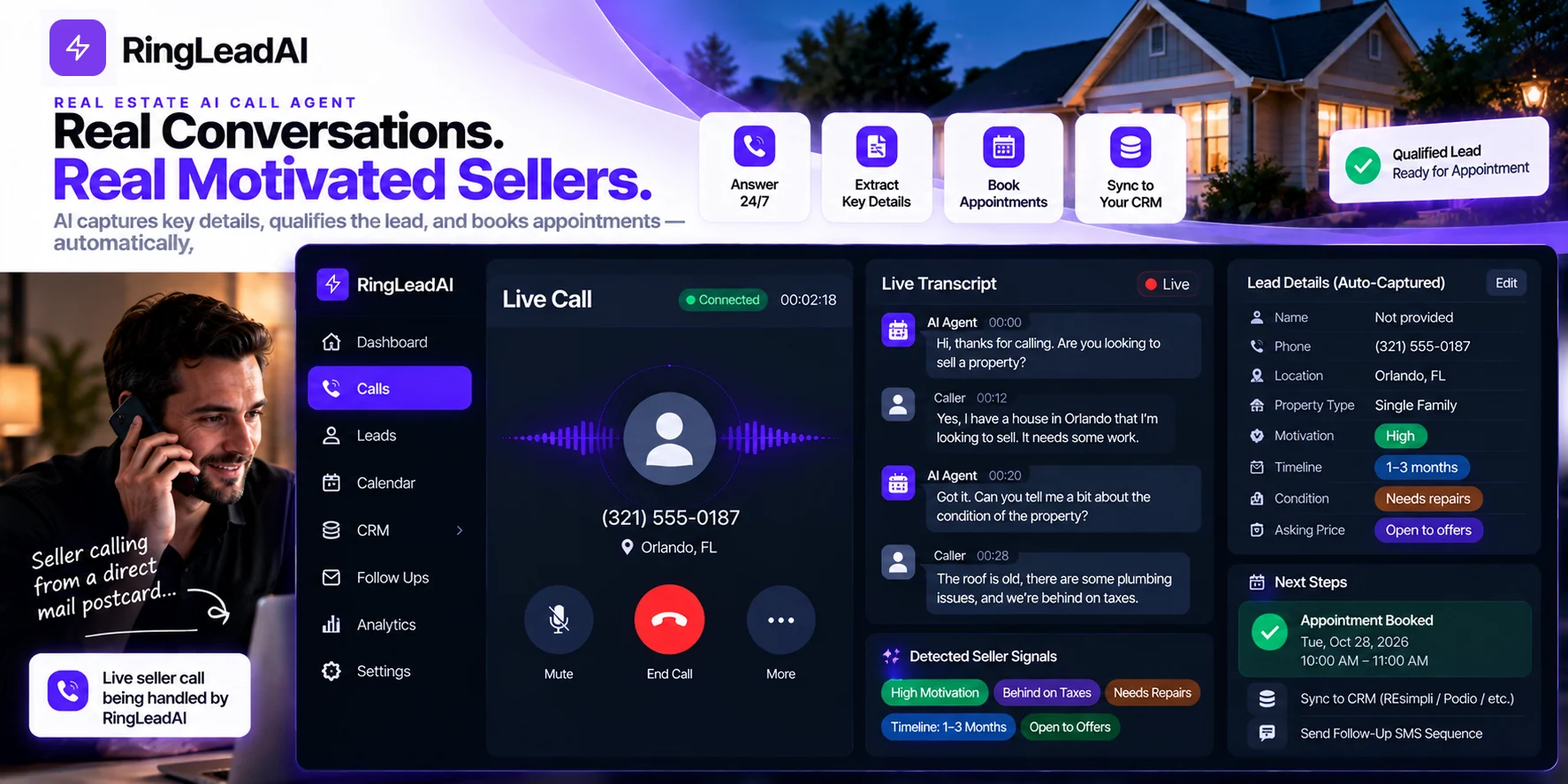
Step 2: Qualify the Seller (The Four Pillars)
Instead of interrogating the homeowner, the agent holds a natural conversation built around the four criteria needed to underwrite any wholesale or flip deal:
- Motivation: “What's prompting you to consider selling the property right now?”
- Timeline: “Ideally, how quickly are you looking to close?”
- Condition: “What kind of repairs or updates would the house need before listing it on the open market?”
- Price expectation: “Do you have a rough figure in mind that would make sense for an as-is cash sale?”
Along the way it notes the secondary context — occupancy (tenant-occupied or vacant), mortgage balance, liens, MLS status, and competing offers — and applies the triage rules you write into its prompt:
- Hot: clear distress (pre-foreclosure, tax auction, probate dispute), short timeline (under 30 days), realistic pricing.
- Warm: clear motivation, flexible timeline (30–90 days), negotiable on price.
- Cold / nurture: retail price anchor, curious about market value, no pressing timeline.
Step 3: Book, Transfer, or Nurture
Hot sellers → live transfer
The agent warm-transfers to your acquisitions manager's mobile, briefing them on the address, timeline, distress factor, and asking price first. If nobody answers, it takes a message and texts the details to your team member.
Warm sellers → booked appointment
The agent offers open slots from your calendar through Cal.com (which syncs Google Calendar or Outlook) and books the walkthrough or underwriting call.
Cold sellers → logged for follow-up
The agent records the price anchor and situation. Sellers who gave written consent can get a follow-up call later through a voice campaign, with calling hours and your Do-Not-Call list applied.
Every call lands in the Call Library with its recording, transcript, and summary, and webhooks or Zapier pass it to your investor CRM.
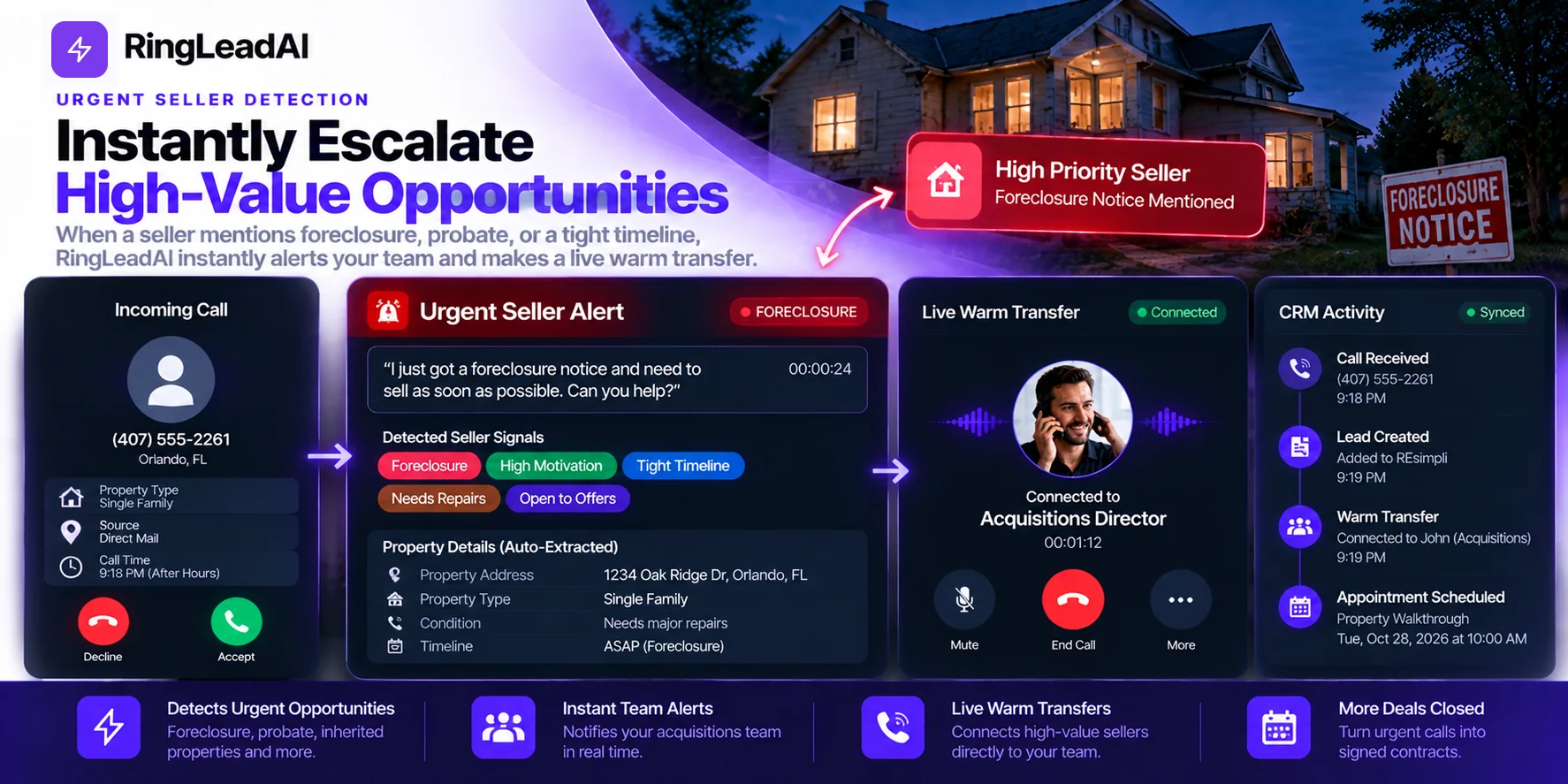
Seller Call Scenarios: Sample Transcripts and Routing
Five common call types and how the agent can route them. These are illustrative scripts to configure against — adapt the wording to your company and market.
1. Inbound Postcard Response (After Hours)
8:40 PM · Direct mail postcard (absentee owner list) · Out-of-state landlord with an empty rental.
“Yeah, I got this yellow card in the mail about my rental on 4th Street. My tenants trashed the place and moved out last week. I live in Ohio and I'm tired of dealing with it. What kind of offer are we talking about here?”
“Thanks for reaching out, Mr. Davis. We can purchase that home completely as-is, meaning you won't need to drive down, clean out the trash, or make any repairs. To make sure we give you an accurate number, how quickly were you looking to wrap this up?”
“Honestly, by the end of this month. I don't want to carry another month of insurance and property taxes on an empty house.”
“Understood. And besides the cleanup from the tenants, does the property need major updates — like the roof, HVAC, or plumbing?”
“The AC unit is dead, and the kitchen cabinets are destroyed. It probably needs $25,000 in work easily.”
“Got it. Taking the repairs and as-is condition into account, did you have a bottom-dollar figure in mind you needed to walk away with?”
“If I could walk away with $95,000 clear, I'd sign tomorrow.”
“That gives our acquisitions team a clear picture. I'd like to have our local acquisitions lead, Marcus, run the comps and give you a firm number. Would tomorrow morning at 9:00 AM or 11:30 AM work best for a 10-minute review call?”
Outcome: 9:00 AM review call booked; the summary — absentee, end-of-month timeline, $25k repairs, $95k ask — is waiting for Marcus.
2. Inherited Property (Probate)
11:15 AM · Probate filing mailer · Grieving child handling an estate full of personal property.
“Hi, I'm calling about the letter you sent regarding my mother's home on Oak Avenue. She passed away last month… My brother and I don't really know what to do with the place. It's full of fifty years of her things, and we haven't even finished the court paperwork.”
“First off, I am very sorry for your loss. Please take your time — there is no pressure here. When you work with us, you don't need to clear out the house; we handle the remaining furniture and belongings. Are you and your brother working with an attorney on probate, or just getting a sense of your options right now?”
“We have an attorney, but the estate isn't formally closed yet. We just want to know if someone can buy it without us having to pack everything up.”
“We can handle the property exactly as it sits today. Because these situations have a lot of moving parts with the court, I'd like to connect you with our senior acquisitions specialist rather than run through basic questions. Would it be alright if he called you this afternoon around 2:00 PM?”
Outcome: callback booked for the senior buyer, tagged probate / high empathy. Price questions skipped entirely to preserve rapport.
3. Pre-Foreclosure With an Approaching Auction Deadline
6:10 PM · PPC search (“sell house fast foreclosure”) · Distressed owner facing a confirmed sale date.
“I need to know if you guys actually have cash right now. The bank scheduled an auction date for my property in three weeks. Can you actually close before that, or is this a scam?”
“We work with situations like this regularly and can move quickly once title is reviewed. Who is your current lender, and what is the exact date of the scheduled sale?”
“The sale date is November 18th. I'm three months behind.”
“Understood. Because November 18th is right around the corner, I'm going to connect you directly to our lead acquisitions manager now so we can look at your options. Please stay on the line for just a moment.”
Outcome: immediate warm transfer to the acquisitions manager, briefed on the sale date and arrears.
4. Tire-Kickers, Wrong Numbers, and Listing Agents
Not every call is an off-market deal. Low-intent calls waste hours of closing time if they reach human reps:
- The retail dreamer (“Zillow says my home is worth $450,000, and I won't take a dime under that”): the agent explains that the cash model suits properties needing speed or major updates, records the price expectation, and marks the call low-intent — no alert to the live desk.
- The wrong number (“You sent a postcard to David, but he hasn't lived here in four years”): the agent apologizes and logs the number so your team can suppress it from future drops.
- The listing agent (“I have an MLS listing coming up in 75204…”): the agent notes the address and list price and routes it to your dispositions inbox rather than the wholesale intake desk.
5. Opted-In Follow-Up Call
Day 7 check-in · Web lead with written consent on the form
“Hi John, this is the acquisitions assistant following up from Cash Home Buyers. You submitted an inquiry last week about your home on Maple Street. Are you still looking to review an as-is cash offer?”
“Actually, we had an agent come out. She thinks she can get us $280,000 on the MLS, so we're leaning that direction.”
“That's completely fine. With an MLS listing you'll want to budget for agent commissions, buyer repair requests, and closing costs. If that route doesn't work out, our offer stays on the table. Would it be alright if we checked back in two weeks?”
Outcome: marked MLS listing pending, with a two-week callback — no acquisitions time spent.
Spanish-Speaking Sellers
In markets like Texas, Florida, Arizona, California, and Nevada, many distressed owners speak Spanish as their first language. Each RingLeadAI agent speaks one language, chosen from 16 — Spanish included — so run a Spanish-speaking agent on its own number and print that number on your Spanish-language mail and ads. It runs the full four-pillar qualification in Spanish, and the call's transcript and summary are waiting for your team.
If your team has no bilingual acquisitions rep, set the agent's transfer and booking rules to route these calls to a bilingual closer or partner.
Built for Your Existing Stack: Integrations and Setup
RingLeadAI works as an intake layer between your inbound phone numbers and your existing pipeline — you don't rebuild your acquisitions stack around it.
What connects in RingLeadAI today:
- Calendar: Cal.com booking during the call, syncing Google Calendar or Outlook.
- CRM: native sync with Salesforce, HubSpot, Pipedrive, and Close.
- Everything else: signed webhooks and Zapier after each call, Slack alerts for bookings, and the API request tool, which lets the agent call any REST API during the call.
Whichever route you use, send these fields on every call:
- Attribution: the number dialed and campaign source (from your tracking platform).
- Property and contact: owner name, callback number, property address, occupancy status.
- Underwriting: motivation, timeline, condition and repair notes, asking price.
- Assets: recording link, transcript, summary, triage result, and the next follow-up task for your rep.
Lead Data, Dialers, and Call Routing
- List engines (PropStream, DealMachine): the absentee, pre-probate, and driving-for-dollars lists you pull here feed the mail drops and PPC funnels that generate inbound calls.
- Outbound dialers (BatchDialer, Mojo): keep human cold calling on your dialer during the day; when prospects call back after hours, route those numbers to the agent instead of a dead voicemail box.
- Tracking numbers (CallRail, smrtPhone): keep your tracking setup and set each number's forward-to destination to the agent's phone number. The source stays logged in your tracking platform.
- Scheduling and contracts: appointments go onto your team's calendar through Cal.com; once your acquisitions manager walks the property and agrees a price, your team sends the purchase agreement as usual.
Step-by-Step Setup Checklist
- Create an inbound agent and attach a phone number to it.
- Forward your CallRail or smrtPhone tracking numbers to that number.
- Write the four-pillar questions, your buy box (markets, discount targets, excluded zip codes), and the Hot / Warm / Cold rules into the prompt.
- Set transfer triggers — e.g., an immediate warm transfer when the timeline is under 14 days or an auction date is mentioned.
- Connect Cal.com for booking, and webhooks or Zapier for your investor CRM.
- Run 5–10 test calls in the browser: probate, angry caller, urgent pre-foreclosure, wrong number.
- Go live on after-hours and weekend lines first, then review every transcript before adding daytime lines.
What You Can Recover: The Marketing-Spend Recovery Framework
Stop guessing how much your missed calls cost. Work it through with your own numbers — here is an example:
- Before: you invest $4,000 a month in direct mail and Google Ads. Your team covers business hours but misses an estimated 10 to 15 after-hours calls a month. Those callers hit voicemail, leave no message, and dial a competitor — 30 to 45 paid opportunities lost every quarter.
- After: the AI agent answers those calls, qualifies each homeowner, and books the motivated ones onto your acquisitions calendar. Your team converts just one of those previously lost leads each quarter into a signed purchase agreement.
- Bridge: at an example assignment fee of $8,500, one recovered contract a quarter is $34,000 a year — more than eight months of that $4,000 marketing budget.
Then compare it with the subscription on RingLeadAI's pricing page: one assignment fee typically covers it many times over.
Annotated Sample Call: An Inherited Property
Reading about AI intake is one thing; seeing how it should handle a grieving heir with a house full of belongings and title questions is another. This annotated script shows the pacing, empathy, and qualification to configure for.
| Time & speaker | Dialogue | What the agent is doing |
|---|---|---|
| 0:02 — AI agent | “Thank you for calling Cash Home Buyers. I'm Alex, an automated intake assistant. This call is recorded for quality. How can I help you today?” | Disclosure up front: AI identity and recording, before any questions. |
| 0:12 — Caller | “I got this yellow letter about my mom's house on Evergreen. She passed away last month, and my sister and I just can't keep up with it. The roof leaks, it's full of stuff, and we live three hours away.” | Probate context, absentee executor, roof leak and contents noted. |
| 0:28 — AI agent | “First, I am truly sorry for your loss. We buy properties completely as-is, so you don't have to clear out a single item or make repairs. Are you and your sister looking to settle this within the next month, or just exploring options?” | Empathy first, then Timeline — without sounding transactional. |
| 0:49 — Caller | “The property taxes are coming due on the 1st of next month, and neither of us wants to pay them. If we can close in three weeks, that would take a huge weight off.” | Urgent timeline (under 30 days) and a clear financial pressure point. |
| 1:04 — AI agent | “We can work within a three-week window. Aside from the roof, are there other major repairs — HVAC, plumbing, or foundation?” | Condition: probes for the big capital items the underwriting desk needs. |
| 1:18 — Caller | “The AC died two summers ago, and the bathroom needs a full gut. It's mostly cosmetic, but dated — 1970s everything.” | Roof, HVAC, and cosmetic scope logged as underwriting notes. |
| 1:30 — AI agent | “Have you and your sister finished the probate process with an attorney, or is that still moving through the courts?” | Title triage: can the deed transfer now? |
| 1:41 — Caller | “The attorney filed the paperwork. I have letters testamentary naming me independent executor.” | Signing authority confirmed. |
| 1:52 — AI agent | “That makes things simpler. Did you have a figure in mind you were hoping to walk away with after all fees?” | Price expectation, asked softly — no lowballing. |
| 2:03 — Caller | “A remodeled house down the street sold for $220k. If we could get $120,000 cash and walk away without cleaning it out, we'd be thrilled.” | Price anchor recorded against a comparable. |
| 2:18 — AI agent | “That gives us a clear path forward, Sarah. Because timing matters with your taxes, I'd like our senior acquisitions lead, Marcus, to review the comps and set up a quick walk of the home. Does tomorrow at 2:00 PM or Thursday at 10:00 AM work better?” | Next step: books from the acquisitions calendar. |
| 2:37 — Caller | “Tomorrow at 2:00 PM works great.” | Appointment booked; summary ready for Marcus. |
Illustrative script, not a recording of a real call.
What to look for:
- Pacing: the agent doesn't cut the seller off when they pause to collect their thoughts (interruption sensitivity is adjustable).
- No premature price clashes: it notes the anchor price and moves on — no MAO formula over the phone.
- No scripted rigidity: when probate comes up, it addresses the paperwork reality instead of rapid-fire questions.
- A usable record: the call ends with a recording, transcript, and summary your rep can read in a minute — not a voicemail to transcribe by hand.
Is It Legal? TCPA, AI Voice Rules, and Call Recording for Real Estate Investors
If an acquisitions platform says compliance doesn't matter, walk away. One bad campaign can lead to class-action litigation. Here is how the rules apply to AI voice in real estate.
| Lower risk: inbound calls | High risk: outbound cold calls |
|---|---|
| The homeowner dials you | The AI initiates the call |
| Established intent | Requires prior express written consent (PEWC) |
| Clear AI disclosure | Statutory damages per call |
| Standard recording laws | Cold skip-traced lists are off-limits for AI |
Inbound Calls: Low Risk, High Intent
When a seller picks up your postcard, clicks your PPC ad, or dials your bandit sign, they start the conversation. Answering with an AI intake agent is generally low-risk, provided you:
- State at the start of the call that the caller is speaking with an AI assistant.
- Offer an immediate way to reach a person.
- Disclose that the call is recorded, in line with state recording laws.
Outbound Calls and the FCC AI-Voice Ruling
On February 8, 2024, the Federal Communications Commission issued a unanimous Declaratory Ruling confirming that AI-generated voices are “artificial or prerecorded voices” under the Telephone Consumer Protection Act (TCPA).
- The rule: don't place outbound AI telemarketing calls to consumer cell phones without prior express written consent.
- The exposure: TCPA statutory damages run from $500 to $1,500 per violation, per call.
- The application: never load a cold skip-traced list from PropStream or DealMachine into an AI voice campaign. Cold outreach to homeowners belongs on compliant human dialing.
Use AI for inbound calls and for follow-up calls to leads who opted in with written consent. If a seller fills out your “Sell My House Fast” form, capture the consent properly: the timestamp, the source, and the exact checkbox language. For example:
“By clicking ‘Get Cash Offer’, I provide my express written consent via electronic signature to receive calls, pre-recorded messages, and SMS notifications from [Company Name] and its automated intake systems at the phone number provided above, even if my number is listed on any State or Federal Do Not Call registry. Consent is not a condition of purchase.”
Have a TCPA attorney review your form language before you rely on it.
Call Recording Laws and Data Handling
- One-party consent states (the majority): you can record as long as one party — your company — consents.
- All-party consent states: California, Florida, Illinois, Pennsylvania, Massachusetts, and Washington, among others, require every party to be told that the call is recorded.
The simplest approach is one disclosure everywhere — the agent's AI and recording announcement, played before your greeting. Confirm with counsel how continued participation after the disclosure is treated in the states you call.
Distressed homeowners share sensitive details: foreclosure status, tax balances, family disputes. Recordings, transcripts, and summaries stay in your workspace's Call Library, visible to your team; ask any vendor how long data is kept and who processes it — RingLeadAI publishes its sub-processor list.
Pre-Launch Legal and Operational Checklist
- Turn on the AI and recording announcement on every inbound agent.
- Add a rule to transfer to a person whenever the caller says “agent” or asks for a human.
- Audit every lead form for explicit TCPA consent language with unchecked boxes.
- Limit outbound AI calls to opted-in records with documented consent timestamps.
- Register your business and numbers for A2P 10DLC so texts aren't labelled as spam.
- Keep a Do-Not-Call list and honor every opt-out request.
AI Call Agent vs. Cold-Calling VA vs. In-House Acquisitions Rep vs. Voicemail
Before committing your marketing budget to another hiring cycle — or letting calls roll to a digital dead end — compare the trade-offs:
| Feature | RingLeadAI call agent | Cold-calling VA | In-house acquisitions rep | Standard voicemail |
|---|---|---|---|---|
| Coverage hours | 24/7/365, including nights, weekends, and holidays | Scheduled shifts; gaps on weekends | Office hours; after-hours depends on the rep's cell | Always on, but no conversation |
| Answer speed | As soon as the call arrives | Depends on shifts and queue | Rep is often driving or on another call | Immediate greeting, no engagement |
| Seller qualification | Four-pillar questions and triage rules from your prompt | Script-based; quality varies with turnover | Highest; deep market intuition and live negotiation | None |
| Sensitive sellers | Empathy, captures estate details, warm handoff | Often sticks rigidly to the script | Exceptional; builds trust on probate and foreclosure | Stressed sellers hang up |
| Follow-up | Opted-in follow-up calls via voice campaigns; every call logged | Depends on manual task discipline | Hot deals crowd out long-term follow-up | None |
| CRM data quality | Recording, transcript, and summary on every call; native CRM sync, webhooks, Zapier | Manual entry; notes often incomplete | Manual entry; shorthand or late | Nothing unless a message is left |
| Compliance risk | Low on inbound and opted-in follow-up; AI and recording announcement, Do-Not-Call list | Moderate to high on outbound | Same as VA for outbound | None — but lost deals |
| Monthly cost | Subscription — see pricing | Wages plus dialer seats and data tools | Salary plus commission per contract | Included with your phone; costs deals |
| Turnover and retraining | None; prompt changes apply to every call | High; constant re-onboarding | Slow and costly to replace | Not applicable |
| Languages | One per agent, 16 available including Spanish | Whatever the hire speaks | Whatever your team speaks | The greeting's language |
| Recordings and transcripts | Every call | Depends on the dialer; rarely transcribed | Depends on the phone system | Voicemail audio only |
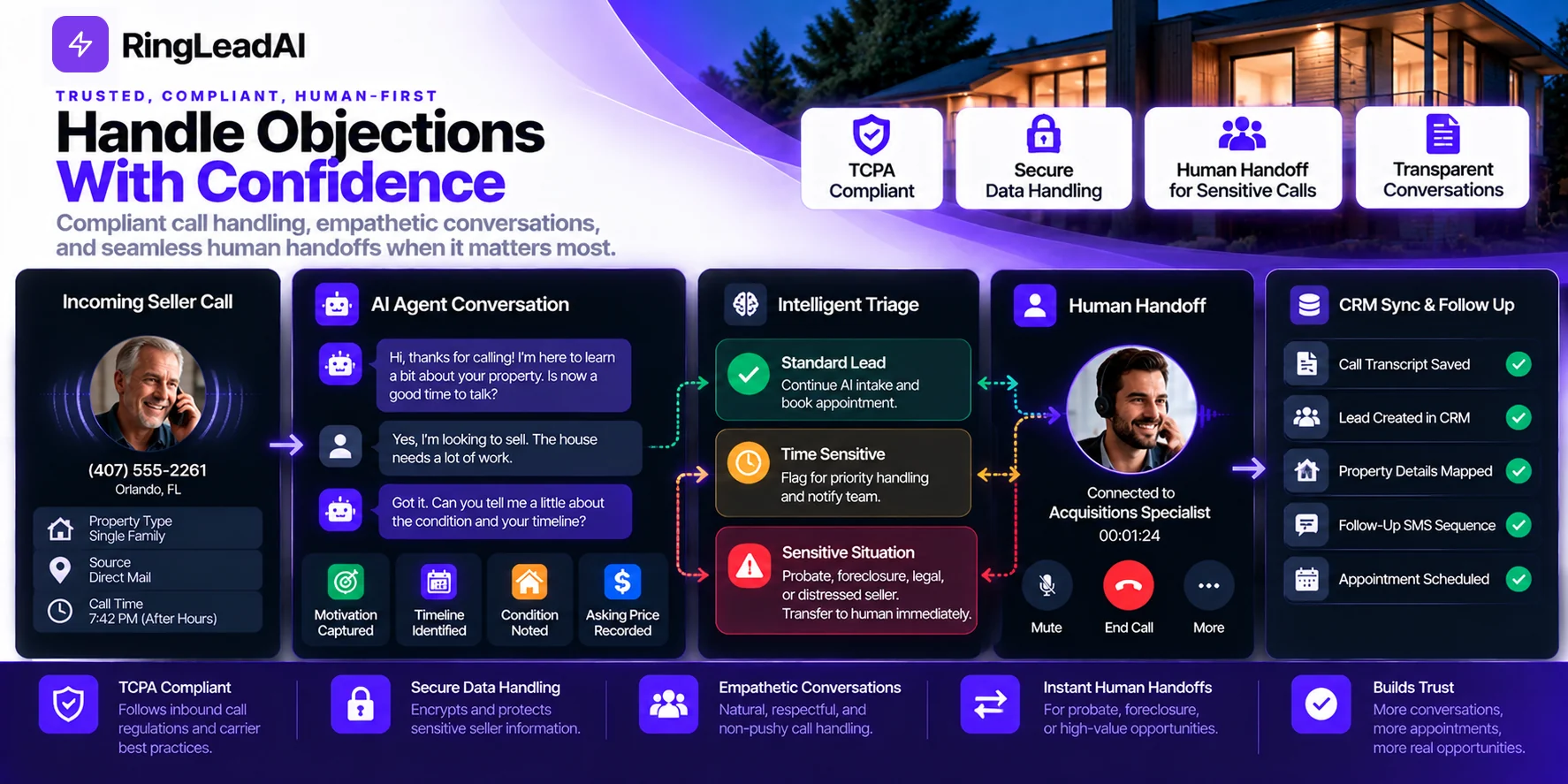
Objection Handling: The Real Questions Wholesalers Ask
“Will motivated sellers just hang up when they realize it's an AI?”
The seller called you. They have water in the basement, taxes due, or a vacant rental draining cash — they want a solution, not a conversation partner. A natural, respectful agent that answers immediately and books an appointment beats a voicemail greeting. State it plainly — “I'm an automated assistant for the buying team. You can say ‘agent’ at any point to reach a specialist” — and callers with a real property to sell keep talking.
“An AI can't negotiate with a grieving heir or someone facing foreclosure.”
Correct — and it shouldn't. It should never negotiate your price, pitch creative financing, or structure a short sale. When it hears an inherited property or a pre-foreclosure, it shifts to intake: empathy, the estate or auction dates, and an immediate warm transfer or priority booking. The AI handles the logistics; your people handle the relationship and the close.
“What happens if the AI logs the wrong property details?”
Every call has a recording, a word-for-word transcript, and a summary. Before calling the seller back or visiting the property, your rep can read the exact quotes about roof age and liens, or listen to the call at 1.5x — and confirms the facts with the seller at the appointment.
“I already have an overseas VA answering my calls.”
Keep them on outbound sourcing, list scrubbing, and deed research. A VA can't cover your lines around the clock without burnout, missed calls, or shift handoffs; the AI agent covers nights, weekends, holidays, and overflow when your VA is off shift or on another lead.
“How technical is the CRM setup?”
Salesforce, HubSpot, Pipedrive, and Close connect natively. For REsimpli, Podio, InvestorFuse, or REI/kit, you'll set up a webhook or a Zapier zap, or have someone comfortable with APIs configure the agent's API request tool — then map Motivation, Timeline, Condition, and Price once and test it.
Lock Down Your Inbound Deal Flow Today
Every time your tracking number rings after 6:00 p.m. or during a busy closing, you are either securing a motivated seller or paying for your competitor's next assignment fee.
- Answer every motivated seller call, 24/7/365.
- Draw out motivation, timeline, repairs, and price expectations on every call.
- Keep a recording, transcript, and summary of every call, and pass it to your CRM.
- Put hot, distressed sellers straight through to your acquisitions team.