Answer the Quote Call Before Another Mover Does
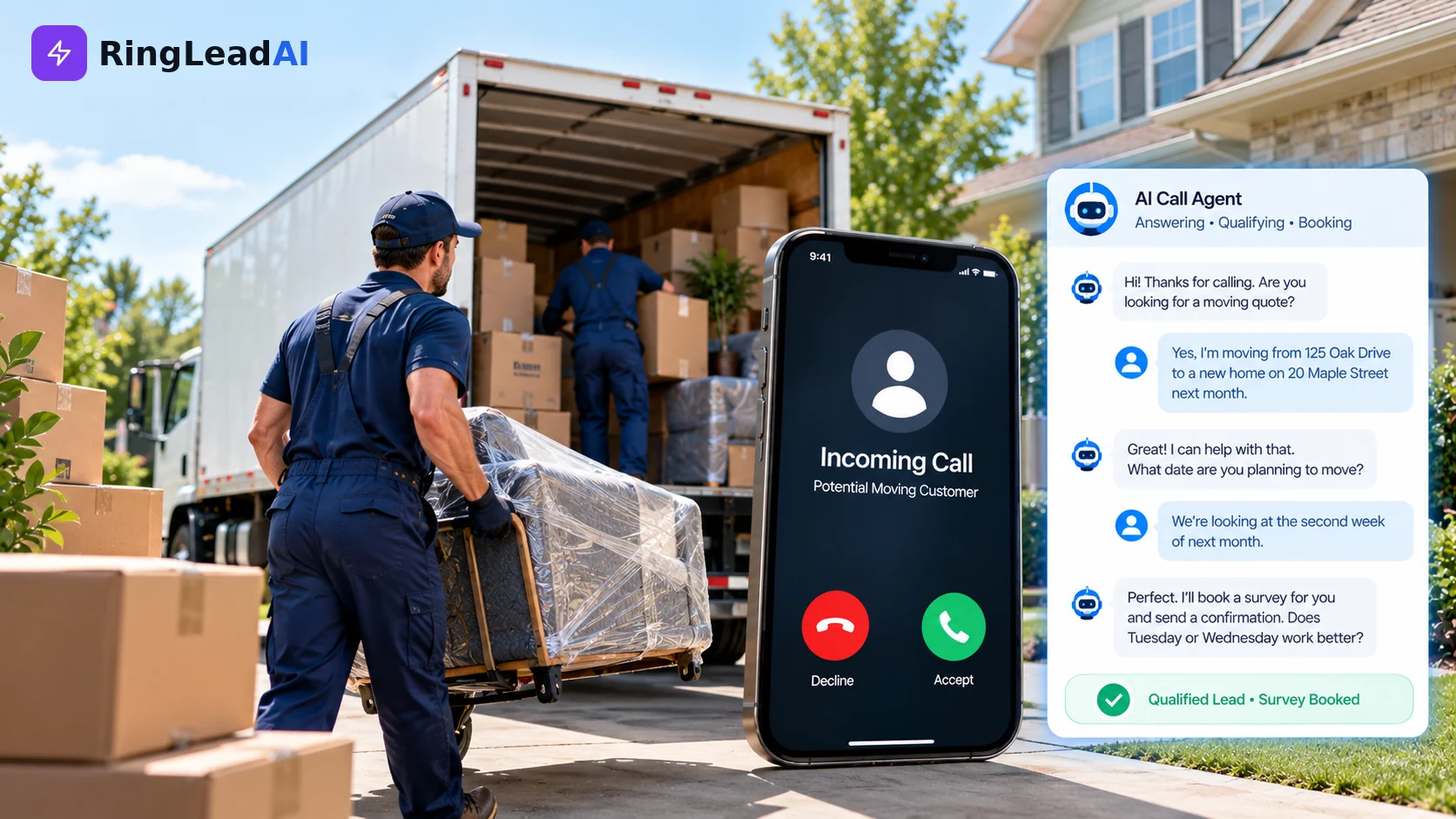
A moving company's next booked move can depend on a single phone call. When a prospect calls for a quote, they want to know whether you serve their area, whether their date is available, and what happens next. If the call reaches voicemail, they may contact another mover before your sales team can respond.
An AI call agent can help close that gap. It answers incoming enquiries, collects the move details your estimator needs, books surveys on a connected calendar, and supports rapid callbacks for eligible leads — while your salespeople are measuring inventory, driving between surveys, or handling existing customers.
The important distinction: an AI call agent qualifies and books; it does not replace a proper moving estimate. It must follow your pricing policy, never invent prices, and route complex jobs to a qualified person.
Why Missed Quote Calls Are Quietly Draining Your Lead Budget
Moving companies pay to generate enquiries through Google Ads, local SEO, referral partners, lead aggregators, and their websites. That investment loses value when prospects can't reach someone or wait too long for a response.
Consider a company receiving 20 quote enquiries a week. If five go unanswered, those five prospects still represent potential business — their actual value depends on move requirements, service-area fit, timing, and likelihood of booking. Not every missed call would have become a customer, but every unanswered qualified enquiry is an opportunity the sales team never assessed.
Peak season makes it harder. Salespeople may be conducting in-home surveys, preparing estimates, coordinating crews, or resolving issues on existing moves when the call arrives.
The Cost of Slow Follow-Up
Speed to lead matters because prospects often contact several movers while comparing availability and estimates; a delayed response gives another mover the first conversation. Treat published industry benchmarks as directional — your own CRM data should drive decisions. Start by auditing:
- Inbound quote calls received.
- The share answered by a person or automated agent.
- Time between a web enquiry and the first callback attempt.
- Qualified surveys booked.
- The share of qualified leads that become booked moves.
- Why leads are lost — price, availability, location, or lack of follow-up.
A human answering service can provide coverage, but whether it can qualify moving jobs, book surveys, and update your CRM depends on the service agreement. Voicemail takes messages, but the customer still waits for a callback. An AI call agent is worth evaluating when missed calls, after-hours enquiries, and inconsistent follow-up are measurable problems.
How an AI Call Agent Works in Three Steps
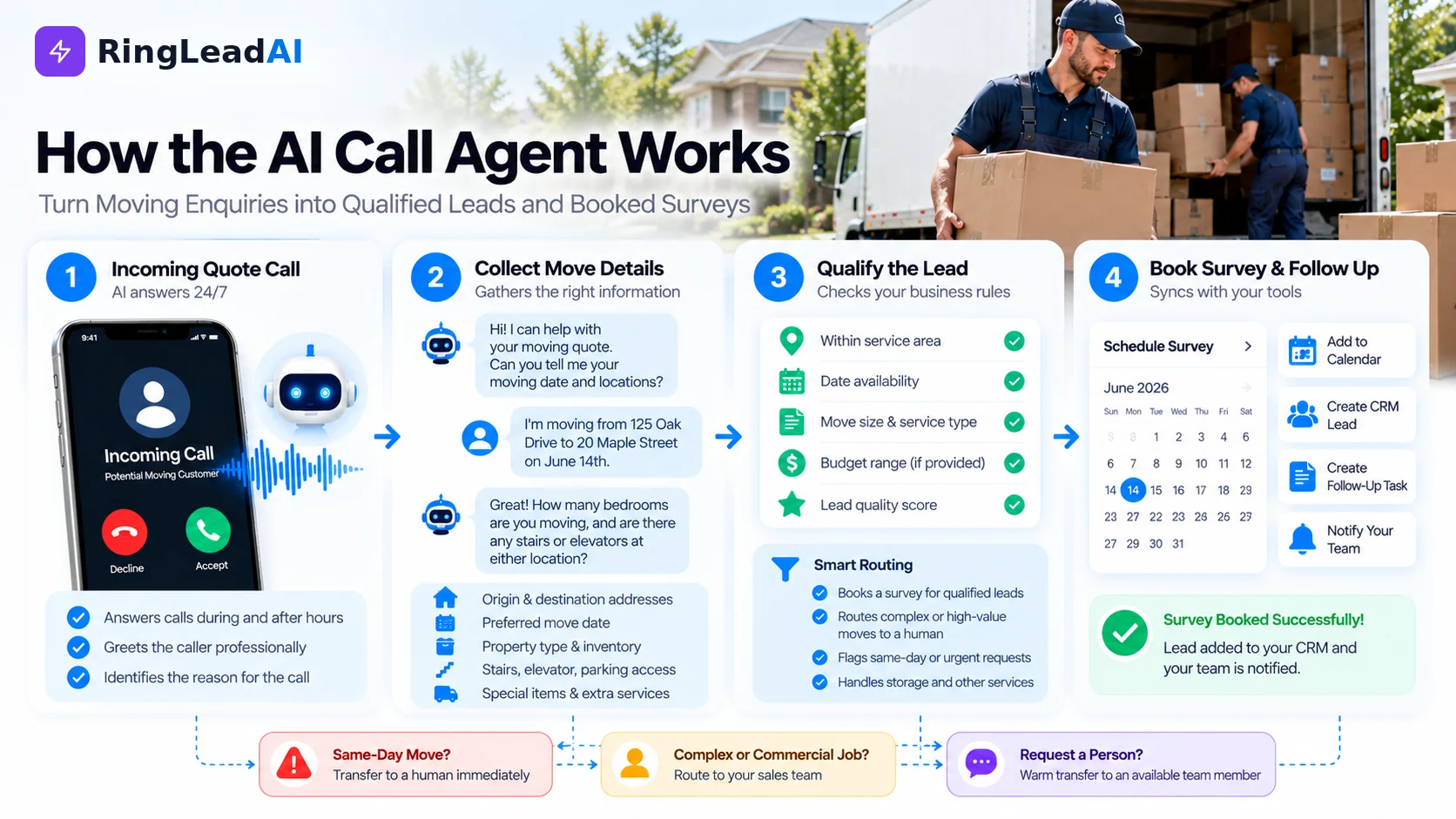
1. Answer the call and identify the enquiry
An inbound agent answers on its own number; forward after-hours calls, overflow when your team is busy, lunch breaks, or more. The AI and recording announcement plays first, so callers know they're speaking with an AI assistant — it sounds professional without pretending to be a human employee.
The agent establishes why the person is calling: a new residential move, a commercial relocation, storage, a labour-only request, or an existing booking. Same-day requests, complaints, claims, and complicated commercial moves go straight to a person instead of a routine script.
2. Collect the move profile without inventing a price
Origin and destination; preferred date and flexibility; property type, rooms, and approximate inventory; stairs, elevators, parking, and long carries; packing needs and fragile items; pianos, safes, hot tubs, or other specialty items; storage, vehicle transport, or extra services; lead source and preferred contact method.
It can share approved information from its knowledge base — a published hourly rate or minimum charge — if you've authorised it. It must not calculate an unsupported total or present a preliminary figure as a binding quote. For interstate household-goods moves, follow the applicable written-estimate process and current federal requirements.
3. Book a survey, transfer the call, or create a follow-up
Where you book surveys through Cal.com, the agent offers real open slots and confirms the booking; it can text the customer the date, time, and next steps. Urgent requests get a warm transfer; if nobody answers, the agent takes a message and texts the details to your team member.
For website, PPC, or aggregator leads, a workflow that starts when a lead is created can place an AI callback — only where the call is legally permitted and the lead source's consent covers it.
Moving Call Scenarios: From Local Moves to Speed-to-Lead Callbacks
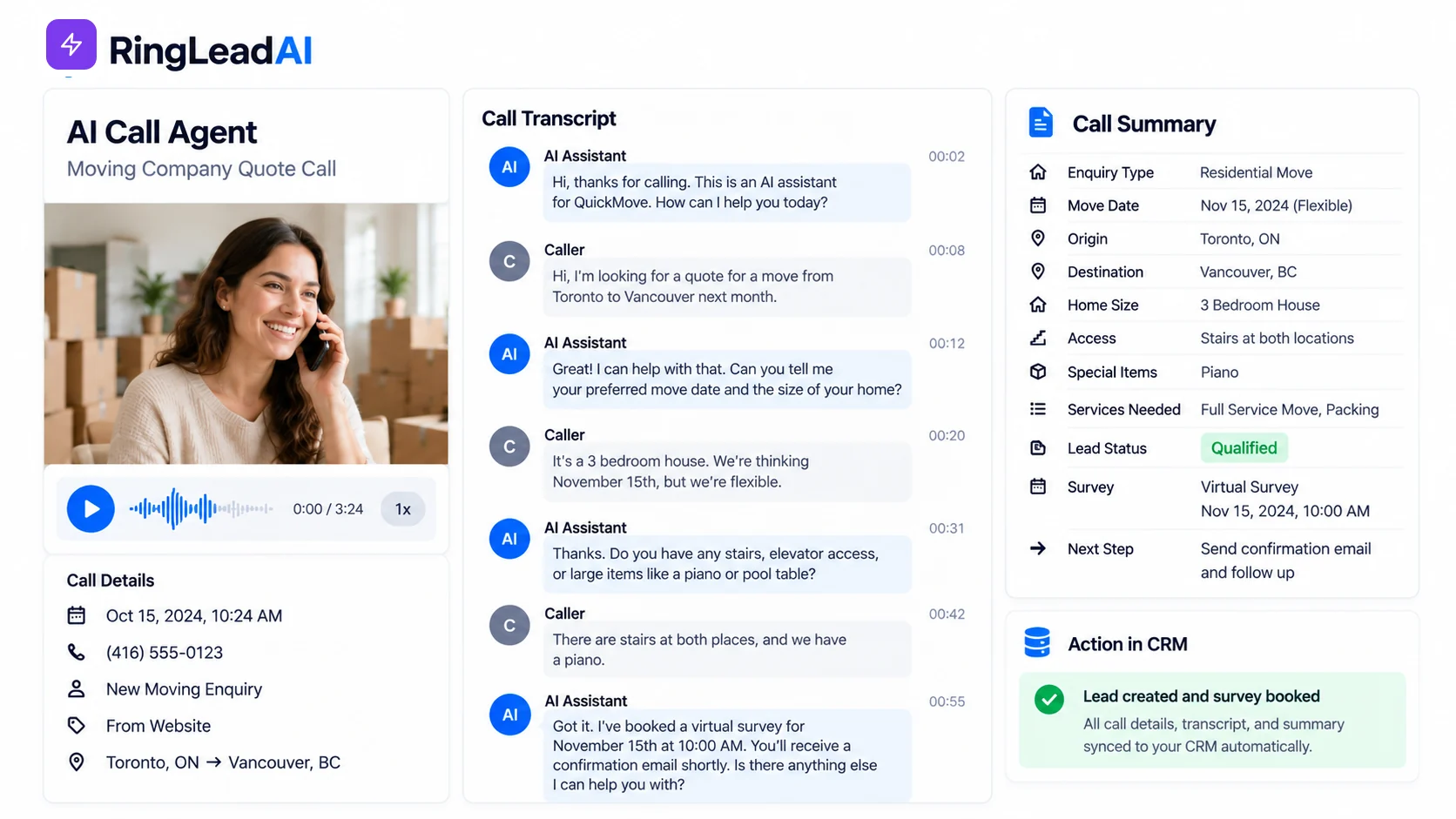
- A local move with a piano: a three-bedroom move across town on the 28th, from a second-floor walk-up, with kitchen packing and an upright piano. The agent captures the date, route, access, packing, and piano details — without pricing it on a standard three-bedroom rate — and offers a confirmed virtual-survey slot, with the piano and stairs visible to the estimator.
- An interstate move: Dallas to Denver in six weeks, with packing, and the prospect wants a total. The agent captures the move, identifies it as interstate, explains your estimate process, and routes it to the right specialist or books a survey — never a final price on request.
- A same-day emergency: a caller needs to move this afternoon. The agent captures the essentials and transfers to dispatch or a designated rep. It must not promise crew availability until the company confirms it.
- Storage or labour-only: separate qualification paths — volume, duration, access, and collection for storage; property, lifting, crew size, and hours for labour-only — instead of forcing every call into a full-service script.
- A website lead needs a callback: a quote form arrives while your team is out on surveys. Where consent is in place, a workflow places the callback, confirms the enquiry, fills in missing details, and arranges the next step. Don't promise a specific callback time you haven't tested.
After the Call: Make the CRM Record Useful
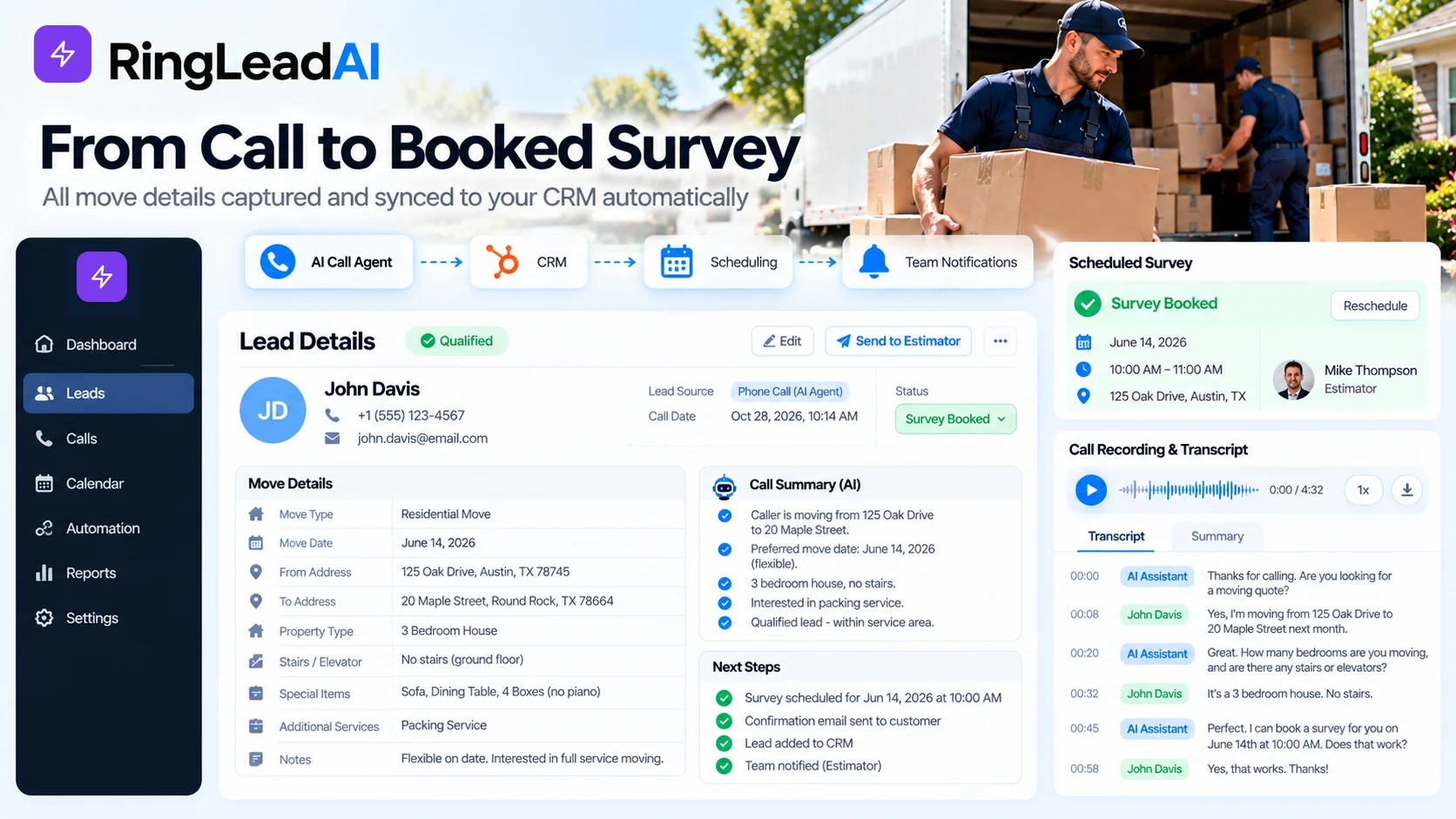
A call is only valuable if the right information reaches the person responsible for the next step. Every call's recording, transcript, and summary lands in the Call Library, and leads sync natively to HubSpot, Salesforce, Pipedrive, or Close.
Set Up the AI Call Agent Before Peak Season
A controlled rollout is safer than routing every call through a new system on day one.
- Confirm call forwarding and the fallback destination.
- Decide which calls the agent handles: overflow, after-hours, or all.
- Connect your CRM and lead sources where supported.
- Write service-area rules and separate paths for local, interstate, commercial, storage, and labour-only.
- Approve every rate, minimum charge, travel fee, and pricing statement the agent may share.
- Define when a survey can be booked and which calendar controls availability.
- Set transfer rules for urgent moves, complaints, complex jobs, and human requests.
- Turn on the AI and recording announcement and review outbound-call consent.
- Test at least 20 calls: normal enquiries, difficult questions, and failures.
- Start with overflow or after-hours coverage, and review the lead records before expanding.
Test more than the happy path: a move outside your service area, a date with no survey slots, an unsupported price, a same-day booking, and a request for a human.
What Could You Recover? A Missed-Lead Revenue Calculator
The value of an AI call agent depends on your lead volume, current answer rate, close rate, job mix, and cost. Use your own figures rather than a generic claim that the software pays for itself — the results are scenarios, not forecasts.
- Potentially missed enquiries = monthly eligible enquiries × (1 − current answer rate).
- Estimated additional bookings = recovered enquiries × assumed close rate.
- Estimated additional revenue = additional bookings × weighted average job value (local and long-distance).
- Revenue after AI cost = additional revenue − monthly AI cost.
Missed-Lead Revenue Calculator
Example values — replace them with your own figures.
Estimated impact
- Potentially missed enquiries
- 36 / mo
- Lead spend on those enquiries
- $1,800 / mo
- Estimated additional bookings
- 7.2 / mo
- Estimated additional revenue
- $14,580 / mo
- Revenue after AI cost
- $14,381 / mo
A planning scenario: not every missed call is a qualified lead, recovered callers may close at a different rate, and revenue is not profit — it excludes the cost of doing the moves.
Compare the Alternatives
| Option | What to consider |
|---|---|
| Voicemail | Low direct cost, but the customer must wait for a callback |
| AI call agent | Subscription and usage, plus setup and compliance review |
| Human answering service | Contracted coverage, call-handling scope, and per-call or per-minute charges |
| Seasonal hire | Recruitment, training, wages, supervision, and availability outside the season |
Compare each option's cost with the qualified surveys and booked moves it actually produces.
Hear It Work: Quote Call and Speed-to-Lead Callback
These are illustrative scripts, not recordings or evidence of any provider's performance.
Example 1: Local moving quote call
“Thank you for calling. I'm the AI assistant for the moving team. I can collect your move details and help arrange a survey. If you'd prefer a person, I can help route your request.”
“I need to move a three-bedroom apartment across town on the 28th. We also have a piano.”
“I can help with that. What's the pickup ZIP code, and where are you moving to?”
“Pickup is 75201, and we're moving to 75230. It's the second floor, no elevator — and we need help packing the kitchen.”
“I have the move date, route, second-floor access, piano, and kitchen packing noted. I can't confirm a total price without an assessment, but I can check whether a survey appointment is available.”
The agent should only offer real calendar availability, and confirm only after the appointment is booked.
Example 2: Callback after a web enquiry
“Hello, I'm the AI assistant calling on behalf of the moving company about the quote request you submitted on its website. Is now a good time to discuss your move?”
“Yes — we're moving from 75001 to 75024 on the 15th. We need packing, and we have a piano.”
“I'll include those details for the estimating team. Would you prefer a virtual survey or an in-home appointment, if one is available?”
Use outbound callbacks only after verifying consent and lead-source terms. A useful demo shows that the agent identifies itself, collects the move profile, handles interruptions, never invents prices or availability, offers genuine survey slots or routes to a person, records accurately, and handles failed transfers responsibly.
Quoting, Consent, and Compliance: What the AI Will and Will Not Say
The agent gathers information and guides the customer to the next step — it never makes commitments the moving company can't honour.
Choose a clear pricing policy
- Option 1 — no price discussion: the agent collects the move profile and arranges a survey or a callback from the estimating team.
- Option 2 — approved rates only: it may share authorised information such as an hourly rate, minimum charge, or travel fee, explaining the limits — never turning it into a total.
- Option 3 — approved starting ranges: for eligible job types, it may share a company-approved starting range with the required qualifications — never as a binding quote or guaranteed final price.
For interstate household-goods moves, follow the applicable FMCSA requirements for estimates and customer documentation, and confirm the current rules before configuring the script.
AI disclosure, recording, and outbound consent
Customers shouldn't be led to believe an automated agent is a person: turn on the agent's AI and recording announcement and review the wording for the jurisdictions you operate in. Recording requirements vary — confirm whether consent is required, how recordings are stored, who can access them, and how deletion requests are handled.
The FCC's February 8, 2024 ruling confirmed that AI-generated voices fall within the TCPA's restrictions on artificial or prerecorded voices. Before enabling outbound callbacks, review your quote-form wording and aggregator consent terms, document each lead's source and consent, and keep opt-outs, do-not-call, and calling-time rules in place — RingLeadAI's voice campaigns apply calling hours and a Do-Not-Call list. A customer submitting a phone number doesn't resolve every compliance question; get legal advice where the rules are unclear.