Answer Every New-Patient and Consultation Call
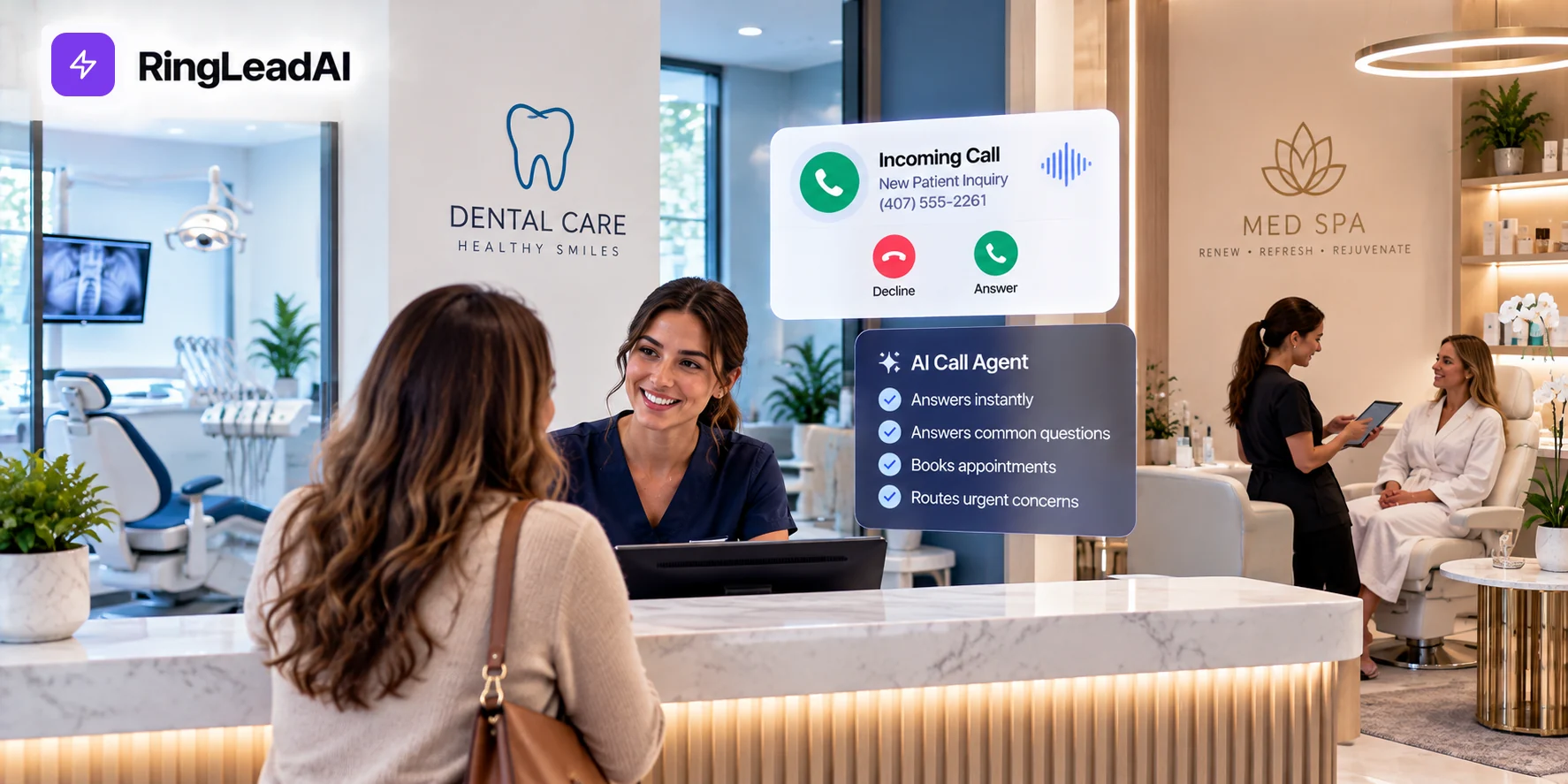
Your front desk is checking in patients, coordinating treatment, and managing the schedule. Then another new-patient call comes in.
If nobody answers, that caller may contact another practice.
RingLeadAI's AI call agent is designed to help dental practices and med spas handle routine inbound calls, respond to common questions, and support appointment booking according to approved rules. With the right configuration, it can help cover busy periods and after-hours inquiries while routing clinical questions and situations requiring human judgment to staff.
Spend less time chasing missed calls and more time supporting the patients already in your practice.
Why Missed Calls Can Drain Production
A missed call is not always a lost appointment. Some callers will leave a voicemail or call back. Others will move on to another practice.
The challenge is that front-desk teams cannot always answer every call while checking in patients, processing payments, coordinating treatment, and responding to existing patient concerns.
For a dental practice, an unanswered call might be a new patient requesting an examination, an existing patient looking for a hygiene appointment, or someone asking about availability after a dental concern. For a med spa, it might be a consultation request, a question about a treatment series, or a returning client trying to reschedule.
Each call has a different purpose. A useful call-handling system needs to identify that purpose and follow the appropriate workflow.
The impact on dental practices
Dental practices depend on a well-managed schedule. An unfilled new-patient appointment or hygiene recall slot can affect production and create additional work for the front desk.
Missed-call benchmarks vary by practice, phone system, and measurement method. Rather than relying on an industry-wide figure, track your own call volume, answer rate, missed calls, booked appointments, and appointment outcomes.
The impact on med spas
Med spas often need to move callers from an initial inquiry to a consultation before treatment. A caller may want to understand the booking process, ask about an approved price range, or find a suitable consultation time.
A prompt response can help the person take the next step. However, booking a consultation is not the same as converting that consultation into a treatment. Track each stage separately to understand the actual business impact.
Why adding more staff is not always the first answer
Hiring another front-desk employee can provide valuable in-person support and human judgment. But recruitment, training, and scheduling have costs, and one employee cannot always manage every incoming call during a busy period.
An AI call agent can be considered as an additional layer for routine calls and overflow. It should support the front desk, not replace clinical judgment or the personal care patients expect.
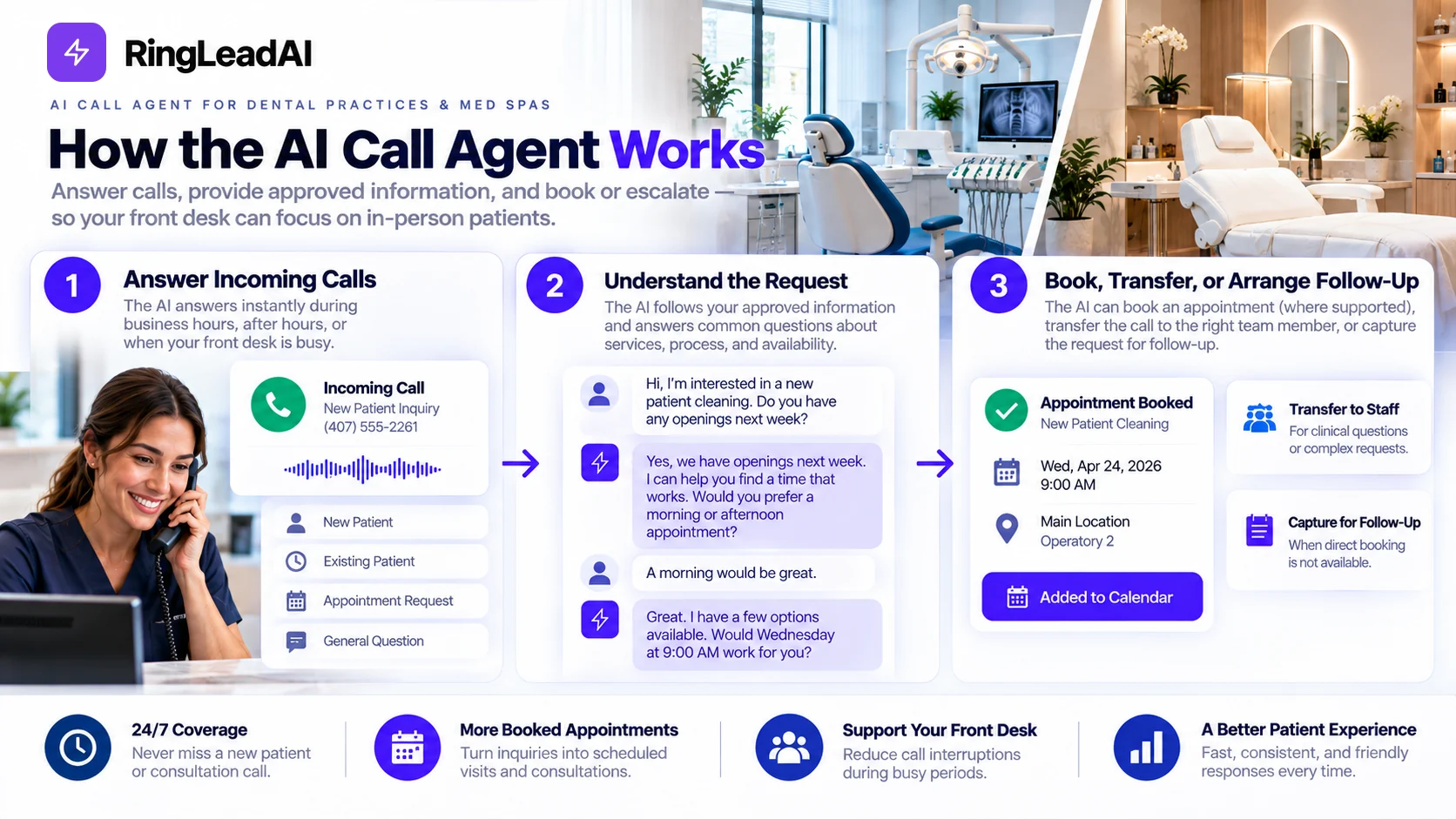
How the AI Call Agent Works in Three Steps
The exact workflow depends on your phone system, booking platform, and the connections available to your practice.
1. Answer incoming calls
An inbound agent answers on its own phone number. Forward calls to it during selected hours, after hours, or when the front desk is busy — call forwarding lets you test the workflow without changing your published number.
The greeting should identify the AI honestly: the agent's AI and recording announcement plays before your greeting, and callers can ask for a person at any point.
2. Understand the request and give approved answers
The agent answers from the knowledge base you load — routine questions, booking procedures, approved service information, and anything else the practice supplies.
It should not diagnose symptoms, recommend clinical treatment, invent prices, or promise insurance coverage. Questions outside its approved scope go to the appropriate team member.
3. Book, transfer, or arrange follow-up
Where the practice books through Cal.com, the agent can offer open slots and book while the caller is on the line. Otherwise it captures the request — every call's recording, transcript, and summary lands in the Call Library — or transfers the caller to staff.
Rules may cover provider, operatory or room, appointment type, duration, consultation-first requirements, and deposits. RingLeadAI has no ready-made connector for practice-management systems such as Dentrix, Eaglesoft, Open Dental, Boulevard, or Zenoti; test any connection through the agent's API request tool, webhooks, or Zapier with your actual scheduling scenarios before going live.
Call Scenarios: Dental Patients and Med Spa Clients
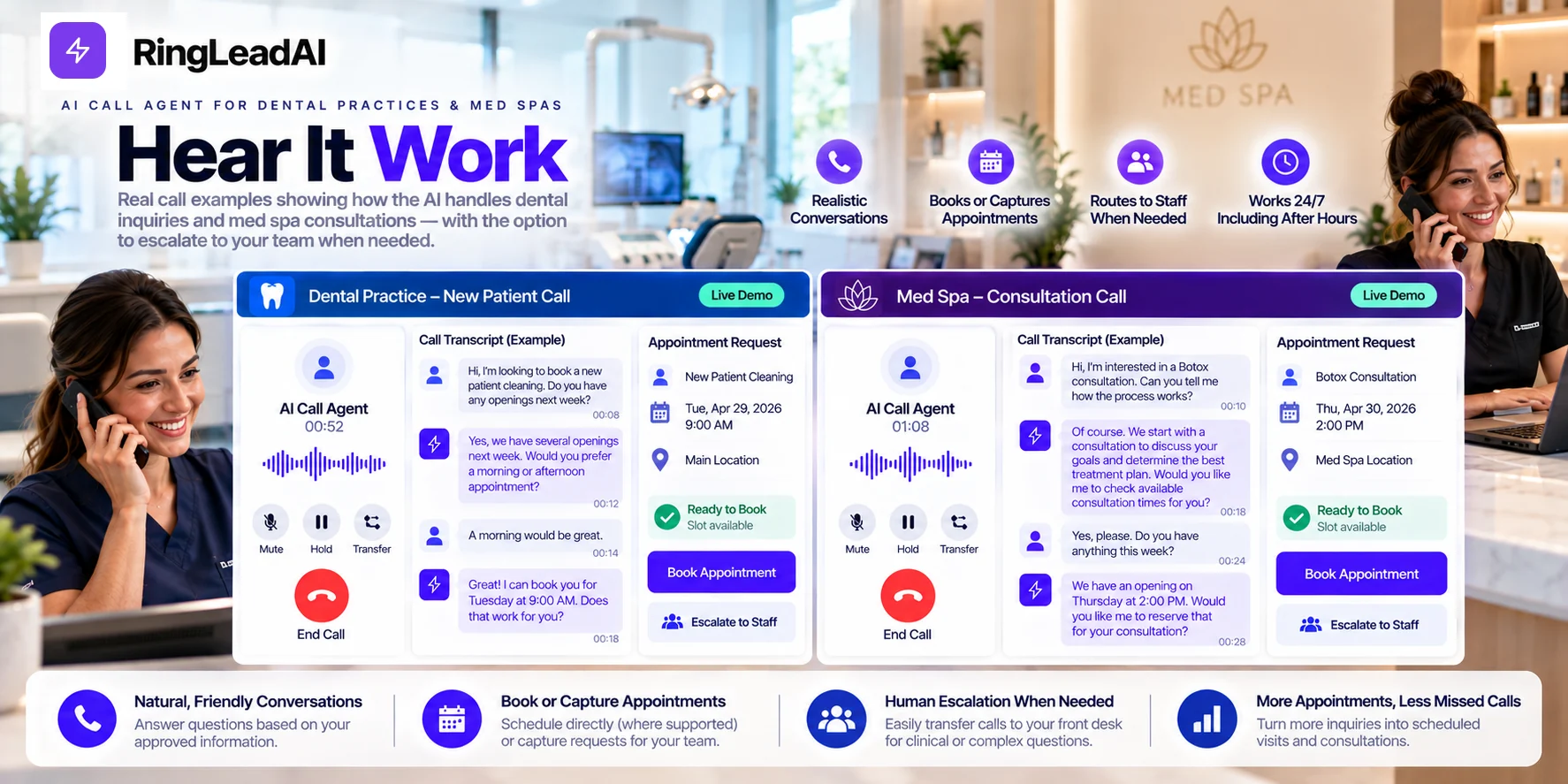
The following conversations are illustrative examples of how an AI call agent could handle routine requests. They are not recordings or transcripts of verified RingLeadAI customer calls.
Scenario 1: New dental patient
“Hi, I'm looking for a dentist. Are you accepting new patients?”
“I can help with that. I can explain the practice's new-patient booking process. Are you looking for a routine examination, or would you like the team to contact you about a specific concern?”
“Just a routine examination — morning, if possible.”
“I'll check the available morning appointments and confirm the details with you.”
The agent should confirm the booking only after the appointment has been created. If it cannot see live availability, it should arrange a staff follow-up instead of promising a slot.
Scenario 2: After-hours dental concern
“I have severe tooth pain and I'm worried something is wrong.”
“I'm sorry you're dealing with that. I can't assess symptoms or provide clinical advice, but I can follow the practice's urgent-call procedure and help connect you with the appropriate team.”
The call should follow the practice's documented clinical escalation policy — for example, a transfer to the on-call contact. The agent must not diagnose the problem or substitute a routine appointment for urgent clinical assessment.
Scenario 3: Hygiene recall
“I received a reminder that I'm due for a hygiene appointment. Friday, if possible.”
“I'll check the available appointments, or arrange for the team to follow up if I can't confirm a slot.”
Recall and reactivation workflows should use appropriate patient permissions, approved messaging, and supported scheduling connections.
Scenario 4: Botox consultation
“I'd like to ask about Botox. How do I book — and can I come in Saturday?”
“I can explain the practice's consultation process and check the available consultation times. The team will discuss your suitability and treatment options during the consultation.”
The AI should not determine treatment suitability, promise a clinical result, or replace the assessment performed by the qualified practitioner.
Scenario 5: Laser treatment series
“I want to ask about laser treatments and whether I need more than one session. Can I book a consultation first?”
“Yes, if the practice has an available consultation slot. The practitioner can advise you about the appropriate treatment plan. I'll check the schedule or arrange a follow-up with the team.”
Configure consultation-first requirements and any room, provider, or duration rules before enabling automated booking.
Scenario 6: Post-treatment concern
“I've had a treatment and I'm worried about a reaction.”
“I'm sorry you're concerned. I can't assess a reaction or provide medical advice. I'll follow the practice's procedure for escalating post-treatment concerns.”
Agree the clinical escalation instructions with the practice before launch. The AI should not improvise reassurance, recommend treatment, or delay the appropriate handoff.
Scenario 7: Spanish-speaking caller
Each RingLeadAI agent speaks one language, chosen from 16 — Spanish included. A practice can run a Spanish-speaking agent on its own number for routine requests in Spanish, with a transfer to staff when the agent can't answer.
Test language handling with real booking scenarios, and confirm the agent transfers callers appropriately when it cannot understand or answer a request.
What You Can Recover: Missed-Call Production Calculator
The value of an AI call agent depends on how many missed calls are genuine booking opportunities, how many of those callers can be converted into appointments, and what those appointments contribute to the practice. Estimate it with your own numbers:
Missed-Call Production Calculator
Example values — replace them with your own call records and figures.
Estimated impact · Dental practice
- Eligible missed opportunities
- 30 / mo
- Potential recovered bookings
- 15 / mo
- Associated monthly production
- $13,500
- Associated annual production
- $162,000
- Production vs. monthly AI cost
- 67.8×
An estimate, not guaranteed revenue or profit. It assumes your booking rate applies to eligible missed callers, and doesn't account for cancellations, no-shows, treatment costs, collections, or appointments that would have been booked anyway.
How the estimate works
- Eligible missed opportunities = monthly calls × missed-call rate × eligible-opportunity rate.
- Potential recovered bookings = eligible missed opportunities × booking rate.
- Dental production uses the first-year production per new patient you enter.
- Med spa production uses the average visit value, visits per series, and consultation-to-treatment rate you enter.
These estimates are not guaranteed revenue or profit. They assume the entered booking rate applies to eligible missed callers and do not account for cancellations, no-shows, treatment costs, collection rates, or appointments that would have been booked anyway.
How to interpret the result
Use the estimate as a starting point, not a promise. Compare it with your actual call records and appointment outcomes after implementation — recovered bookings, attendance, treatment conversion where relevant, and attributable production — and weigh the staff time saved against the ongoing cost of running the system.
Compare the expected benefit with the full cost of each option: an AI call agent, an additional front-desk employee, a virtual receptionist, and voicemail with text-back. The best choice depends on your workload, scheduling complexity, service requirements, and budget.
Two Sample Calls: Dental Booking and Botox Consultation
These examples show the difference between an AI that follows approved rules and one that simply responds to questions.
“I'm a new patient and want to book an examination, Thursday afternoon. Do you accept my insurance?”
“I'll check the available Thursday afternoon appointments. I can share the practice's approved insurance information, but the team will need to confirm the details of your specific coverage.”
“I'd like to book a Botox consultation this evening. Can you tell me the price?”
“I can share the consultation fee the practice has approved. The practitioner will discuss suitability and the recommended plan during your consultation. Let me check whether an evening slot is available.”
When you test your own agent, cover three outcomes for each: a suitable slot is available, no slot matches the request, and the AI needs to transfer the caller to staff.
HIPAA, Consent, and Compliance
Dental practices and med spas need to understand how patient information is handled before allowing an AI system to process calls. A vendor's marketing statement is not enough to establish compliance: review the service configuration, contracts, data flows, and applicable legal requirements before launch.
Business Associate Agreement
Where HIPAA requires it, confirm that a signed Business Associate Agreement covers the relevant services and parties. Review the voice-processing, transcription, hosting, integration, and subprocessor arrangements that apply to the system — and don't assume that a BAA covers every connected service or every feature in a vendor's product.
A signed BAA does not, by itself, make a system HIPAA-compliant. Compliance depends on the applicable obligations, safeguards, contracts, and actual use of the system.
Security and access controls
Ask any provider for documentation covering:
- Encryption in transit and at rest.
- Access controls and permissions.
- Audit logging and administrative access.
- Data retention and deletion.
- Handling of call recordings and transcripts.
- Security assessments or certifications, where claimed.
RingLeadAI does not hold a SOC 2 report, and publishes its sub-processor list.
Call recording and disclosure
Recording and monitoring requirements vary by jurisdiction and situation. Confirm the applicable consent and disclosure rules before recording calls or storing transcripts. The AI should identify itself honestly — turn on the agent's AI and recording announcement, which plays before your greeting — and the practice should decide how callers are informed about recording or processing where required.
Outbound calls, texts, and patient consent
Recall reminders, reactivation campaigns, confirmations, and other outbound communications need their own review. Document the relevant consent, opt-out handling, and communication rules, including applicable TCPA requirements in the United States. RingLeadAI's voice campaigns apply calling hours and a Do-Not-Call list; the consent itself is the practice's to obtain and record.
The FCC has addressed AI-generated voices under the TCPA. Obtain current legal guidance on how the rules apply to your intended calls and messages.
Pricing and Plans
The right plan depends on call volume, number of locations, booking requirements, integrations, and the amount of human support needed. Before choosing a provider, ask what the monthly fee includes and whether there are extra costs for usage, setup, integrations, outbound messaging, or advanced workflows. Here is how RingLeadAI answers each question today:
| Evaluation area | What to confirm | RingLeadAI today |
|---|---|---|
| Monthly subscription | Price, billing terms, and included usage | Voice Starter $49/mo (200 voice minutes), Voice Pro $199/mo (1,000 voice minutes), Voice Scale $499/mo (3,000 voice minutes) |
| Call capacity | Limits on concurrent calls, minutes, or call volume | Voice minutes per plan; parallel calls up to each agent's concurrency setting |
| Booking | Whether direct booking is supported for your platform | Cal.com booking during the call; no direct connector for Dentrix, Eaglesoft, Open Dental, Boulevard, or Zenoti |
| Integrations | Setup costs and ongoing fees, if any | Native CRM sync, webhooks, Zapier, and the agent's API request tool |
| Outbound features | Reminders, recalls, and reactivation | Voice campaigns with calling hours and a Do-Not-Call list, for patients who gave consent |
| Compliance | BAA scope and security documentation | No HIPAA claim; confirm BAA availability with our team first |
| Cancellation | Contract length and cancellation conditions | 7-day free trial, no credit card, cancel anytime |
Current plans and terms are always on the pricing page.
Compare cost with measurable outcomes
A low monthly fee does not automatically make a product cost-effective, and a more expensive option may be right if it meets the practice's scheduling, support, and compliance requirements. Evaluate recovered bookings, attendance, treatment conversion, and attributable production alongside the total cost, over a realistic measurement period — and avoid treating all bookings as incremental revenue.
For a multi-location practice or dental support organisation (DSO), also consider whether the system can support location-specific schedules, permissions, escalation procedures, and reporting — for example, one agent and number per location.
See How RingLeadAI Could Work for Your Practice
Missed calls can create avoidable friction for patients and extra work for the front desk. An AI call agent can help handle routine inquiries and support appointment booking when it is configured around the practice's actual rules.
The goal is straightforward: improve call coverage, help patients take the next step, and give staff a clear process for requests that need human judgment.
Start by identifying when calls are missed and which requests can be handled safely. Test the system with overflow or after-hours calls, review booking accuracy, and measure the results before expanding to additional workflows.