A Deliverability-First Cold Outreach Platform
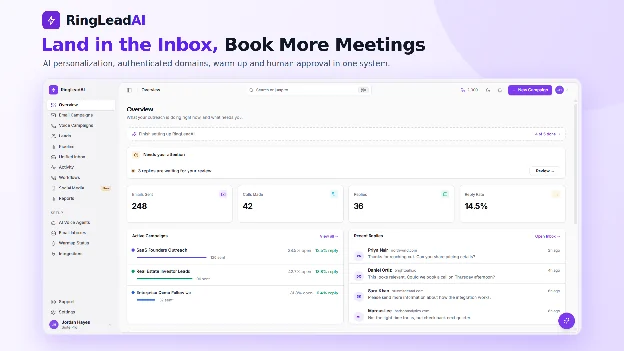
Modern inbox providers (Google Workspace and Microsoft 365) enforce strict deliverability gates. A spike in spam complaints above 0.3% or misaligned DNS records can badly damage your primary corporate domain — crippling not just outbound sales, but critical operational emails to existing clients.
RingLeadAI is architected as a deliverability-first cold outreach platform.
By keeping cold outreach on secondary domains, checking email authentication (SPF, DKIM, DMARC), warming every inbox up gradually, and writing personalized copy with AI, RingLeadAI protects inbox placement and turns outreach into booked meetings.
How the Platform Works: The 4-Stage Engine
An outbound engine must coordinate infrastructure, personalization, and response handling. Here is the operational framework:
Stage 1: Prospecting & Enrichment
High deliverability begins with strict list hygiene. RingLeadAI replaces unvetted CSV dumps with sourcing, enrichment, and verification:
- Account sourcing: Find decision-makers with the built-in Lead Finder, import your own lists, or sync leads from your CRM.
- Enrichment: Fill in contact and company data with Lead Finder or the Enrich Lead workflow step.
- Mailbox validation: Verify addresses before they enter a campaign, and keep hard bounces low — a common guideline is under 2% — to protect domain reputation.
Stage 2: AI Personalization Beyond First-Name Tokens
Generic merge tags like {{FirstName}} and {{Company}} trigger instant pattern fatigue. Anchor copy in an acute business problem instead:
- Generic Template Outreach (High Spam Risk): “Hi Sarah, I noticed you work at a growing SaaS company. We help businesses improve sales efficiency. Would you be available for a quick call this Thursday?”
- Signal-Driven Outreach (High Conversion Alignment): “Hi Sarah, noticed your team posted 4 new SDR roles this week following your Series B. Scaling outbound seat count typically degrades primary domain reputation if warmup schedules aren't strictly isolated. How are you maintaining your sub-0.1% spam complaint ceiling across Google Workspace during this hiring ramp?”
The second variation establishes immediate relevance, speaks directly to executive pain points, and gives the decision-maker a legitimate commercial reason to engage.
Stage 3: Isolated Sending Infrastructure & Warm-Up
Outbound volume should never traverse your root corporate domain (company.com):
- Dedicated secondary domains: Send from lookalike secondary domains (getcompany.com, companyhq.com) and connect their inboxes to RingLeadAI over SMTP/IMAP — Gmail, Outlook, or any provider.
- Authentication: RingLeadAI checks SPF, DKIM, and DMARC on every sending domain. Use 2048-bit DKIM keys and move DMARC toward p=quarantine or p=reject.
- Gradual warm-up: Inboxes ramp through a warmup pool that exchanges real mail and measures inbox placement. Keep spam complaints below 0.1%.
- Automatic halts: A reply stops that lead's remaining follow-ups across email, voice, and social, and an opt-out suppresses the lead everywhere.
Stage 4: Reply Classification, Routing & CRM Sync
Campaign execution represents only half the challenge; rapid response conversion determines closed pipeline:
- Reply classification: Inbound replies are labelled as they arrive — Interested, Meeting requested, Question, Objection, Out of office, Unsubscribe, and more.
- Fast hand-off: High-intent replies surface first in one unified inbox; on calls, AI voice agents book straight onto your Cal.com calendar.
- CRM logging: Leads, replies, and call outcomes sync to Salesforce, HubSpot, Pipedrive, or Close.
Core Operational Metrics: What RevOps Must Measure
Evaluate outbound performance on downstream commercial milestones — not easily distorted vanity metrics:
| Metric | What to aim for | Strategic Importance |
|---|---|---|
| Primary Inbox Placement | Track it per mailbox during and after warmup | Prevents unseen messages from degrading sender score. |
| Hard Bounce Rate | Low — a common guideline is under 2% | Protects secondary and tertiary sending domains. |
| Spam Complaint Rate | Under 0.1%; never reach 0.3% | Google's published sender guidance for bulk senders. |
| Positive Reply Rate | Trending up as targeting improves | Quantifies targeting precision and signal relevance. |
| Cost Per Qualified Meeting | Below your human SDR baseline | Measures true acquisition efficiency. |
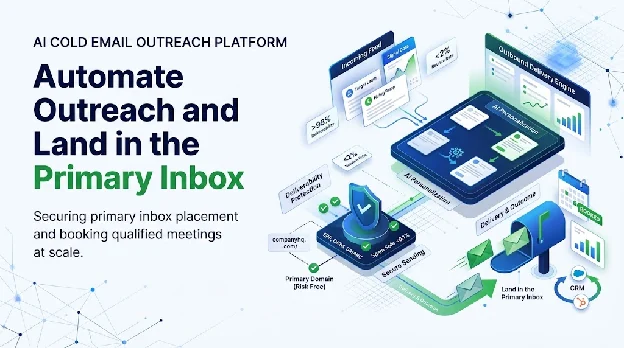
Deliverability & Infrastructure: The Architectural Foundation
Inbox placement is an engineering discipline, not a copywriting exercise. You can craft the most compelling, signal-rich offer in the market, but if your sending domain lacks authentication or carries poor reputation, receiving mail filters will route your message straight to spam.
RingLeadAI approaches deliverability with an infrastructure-first mindset: checking DNS alignment, warming mailboxes gradually, and monitoring sending health to safeguard your sender score.
1. Domain Isolation: Dedicated Secondary & Lookalike Domains
Never send cold outbound from your primary corporate domain (yourcompany.com). A surge in spam complaints or accidental bounce spikes can degrade your domain reputation, jeopardizing critical operational emails, customer support tickets, and invoice deliveries.
- Naming convention: Secure branded lookalike domains (getyourcompany.com, tryyourcompany.com, yourcompanyhq.com) that clearly reflect your business identity without deceptive impersonation.
- Inbox ratios: Configure a maximum of 2 to 3 mailboxes per secondary domain. Concentrating sending volume across too few inboxes triggers rate-limiting.
- Tenant isolation: Provision sending mailboxes across separate Google Workspace or Microsoft 365 tenants to isolate provider-level reputation.
2. Email Authentication: SPF, DKIM & Strict DMARC
Receiving mail transfer agents (MTAs) at Google, Microsoft, and corporate firewalls evaluate three pillars to authenticate sender identity. Misconfiguration results in immediate delivery degradation:
- SPF (Sender Policy Framework): Publishes authorized sending IPs and service hosts in the domain’s DNS TXT records. Stay within the 10-DNS-lookup limit.
- DKIM (DomainKeys Identified Mail): Signs outgoing messages with a private key (use 2048-bit keys). Receiving servers verify the public key via DNS, proving the message wasn't altered in transit.
- DMARC (Domain-based Message Authentication, Reporting & Conformance): Enforces SPF and DKIM alignment against the visible From: address. Roll it out in stages:
- Stage 1: p=none (monitoring mode with aggregate RUA reports).
- Stage 2: p=quarantine (routes failed alignment checks to spam folders).
- Stage 3: p=reject (full protection; blocks unauthenticated mail).
RingLeadAI checks SPF, DKIM, and DMARC for every connected sending domain, so a broken record is visible before it costs you placement.
3. Mailbox Warm-Up & Ramp Profiles
New domains and fresh mailboxes carry zero historical sender reputation. Sudden spikes in outbound velocity trigger automated spam filters.
- Paced pool ramping: Sending volume increases gradually over a 2 to 4-week window, through a warmup pool that exchanges real mail and generates genuine engagement — opens, replies, and not-spam signals.
- Reputation tracking: Each mailbox carries a reputation score and measured inbox placement, and warmup restarts on its own when reputation slips.
4. List Hygiene & Bounce Mitigation
Sending to invalid email addresses generates hard bounces, directly signaling to ESPs that your list is scraped or unmaintained.
- Pre-send verification: Verify addresses before sending — in Lead Finder, or with your own ZeroBounce or NeverBounce key.
- Automatic pause: Campaigns pause automatically when bounces spike. A clean list of 300 verified prospects generates vastly more pipeline than an unvetted batch of 10,000 scraped leads.
5. Reputation Monitoring
Successful delivery (a 250 OK server response) does not prove primary inbox placement. Sustained success requires continuous tracking:
- Google Postmaster Tools: Set it up for every sending domain to track domain reputation and user-reported spam rates across Gmail.
- The 0.1% rule: Keep spam complaint rates below 0.1%. Exceeding 0.3% triggers filtering across Google Workspace and Yahoo Mail.
- One deliverability view: RingLeadAI's Warmup Status brings warmup progress, inbox placement, reputation, and recent bounces together.
Deliverability Guidelines
| Metric | Guideline | Source / Action |
|---|---|---|
| Gmail Spam Complaint Rate | < 0.1% (strict ceiling: 0.3%) | Google Postmaster Tools; pause the campaign if exceeded |
| Hard Bounce Rate | < 2.0% (ideal: < 1.0%) | Verify addresses; purge invalid and risky records |
| Warm-Up Ramp Window | 14 – 28 days | Progressive volume ramp per inbox |
| Max Send Volume / Inbox | 30 – 50 outbound emails / day | Protects individual inbox reputation |
Regulatory Compliance & Ethical Governance
Reliable deliverability requires strict adherence to commercial messaging standards:
- CAN-SPAM Act (US): Clear sender identification, a valid physical postal address in email footers, and an easy, working opt-out.
- GDPR & PECR (EU/UK): Documented B2B Legitimate Interest Assessments (LIA), relevant contextual targeting, and prompt respect of opt-outs and erasure requests.
- Suppression: Unsubscribes go on your suppression list, and an opt-out suppresses the lead across email, voice, and social.
Signal-Driven Personalization: Engineering Relevance at Scale
Most cold email personalization fails because it relies on superficial merge tokens — swapping {{Company}} or {{JobTitle}} into static templates that prospects see through in seconds.
Modern decision-makers do not respond to flattery or generic pitches; they respond to operational relevance.
Anchor every pitch to an active business challenge the prospect is experiencing — a funding round, a hiring expansion, a tech-stack migration — instead of an invented compliment.
Intent Signals & Contextual Talk Tracks
High-converting outreach matches an acute business milestone to an immediate, logical solution:
| Detected Trigger / Signal | Where to Find It | Contextual Talk Track |
|---|---|---|
| New Capital Infusion | SEC Form D / Crunchbase / PR | “Congrats on the Series B. As team size ramps, scaling outbound seats without isolated domain infrastructure frequently burns primary domain reputation. How are you isolating your secondary inboxes during this growth phase?” |
| Specific Sales Hiring | LinkedIn Jobs / ATS feeds | “Noticed you just posted for 4 Mid-Market SDRs. Building repeatable outbound cadences from scratch usually bottlenecks rep onboarding. Are you equipping new hires with automated qualification workflows to protect their selling time?” |
| Tech-Stack Migration | BuiltWith / Datanyze | “Saw your team recently migrated to Salesforce. If your revenue operations are auditing integrations alongside that migration, it's a good moment to clean up duplicate contact records.” |
Static Merge Tags vs. Signal-Grounded Copy
The legacy template (zero signal, high pattern fatigue)
Subject: Quick question
Hi Sarah,
I hope this email finds you well. I noticed you work at a growing B2B company. We help enterprises optimize their sales operations and improve pipeline performance. Would you have 15 minutes for a quick call next Tuesday?
Why it fails: Generic opener, zero contextual hook, vague value proposition, and an unearned, high-friction task.
A signal-grounded email (high context, low friction)
Subject: Series B / SDR deliverability ramp
Hi Sarah,
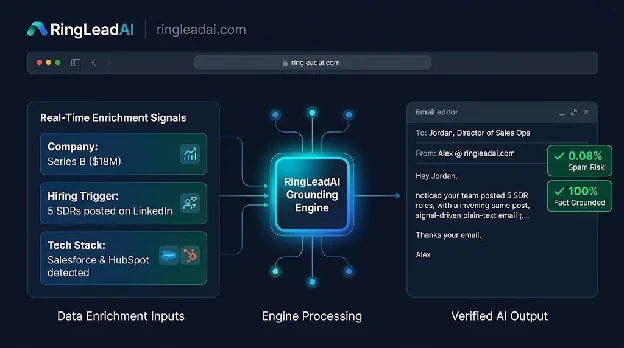
Congratulations on closing the Series B. Noticed your team opened five SDR roles this month in Austin.
Ramping that many outbound seats typically strains sending reputation if inboxes aren't isolated across secondary domains with DMARC enforcement.
Are you currently managing deliverability in-house, or open to comparing notes on how we keep spam rates under control?
Why it converts: Demonstrates verified research within the first sentence, links the hiring trigger to a known operational problem, and closes with a low-friction, conversation-starting question.
Human-in-the-Loop Control
Automation without verification destroys domain equity. RingLeadAI keeps human oversight right where it matters:
- AI drafting: Rynn drafts concise, plain-text emails from your offer, in the reading patterns executives respond to.
- Review before launch: You review, edit, and approve every sequence before it starts sending.
- Replies come to you: Classified replies land in one unified inbox, with a Rynn summary of each conversation.
- Confidence holds: The AI answers routine replies itself, and holds any reply it is not sure about — low confidence, an unfilled placeholder, or a promise it cannot keep — for a person, with a suggested draft ready to edit.
- Automatic halt: The moment a lead replies, their remaining follow-ups stop across every channel, protecting your brand from embarrassing double-sends.
Use Cases: Who Benefits Most from Deliverability-First Cold Outreach?
Outbound pipeline fails when high-volume blast tactics meet sophisticated inbox filters. RingLeadAI is built for revenue teams that need consistent pipeline without risking their core domain or burning SDR hours on manual operations.
1. High-Velocity Outbound Sales Teams (SDRs & AEs)
- The operational bottleneck: Reps spend much of their week scraping contact data, guessing valid emails, and writing repetitive one-off messages — leaving little time for qualified sales conversations.
- The RingLeadAI solution: Enrichment, email verification, and AI drafting are automated; replies arrive classified in one inbox, and CRM activity logs itself.
- The business impact: Reps get back the hours spent on research and admin, while inbox placement stays protected.
2. B2B Lead Generation & RevOps Agencies
- The operational bottleneck: Scaling cold outreach across multiple client portfolios risks cross-contamination. If one client's aggressive campaign incurs high spam complaints, shared infrastructure can drag down every account.
- The RingLeadAI solution: Run each client in its own organization — its own sending domains, inboxes, and suppression list — and switch between them from one login.
- The business impact: One client's campaign cannot affect another client's domains.
3. Account-Based Revenue Teams (Enterprise ABM)
- The operational bottleneck: Senior enterprise decision-makers (C-suite, VP-level) filter out generic outreach immediately. High-value accounts demand deep research, but manual research does not scale.
- The RingLeadAI solution: Outreach anchored to real milestones you have verified — funding, executive hires, tech-stack changes — with your reps reviewing every sequence before it reaches Tier-1 targets.
- The business impact: More relevant outreach to the accounts that matter most.
4. Consultancies & B2B Professional Services
- The operational bottleneck: Boutique firms, legal tech advisories, and technical consultancies depend on firm reputation. Unprofessional, spammy, or legally questionable outreach permanently damages brand credibility.
- The RingLeadAI solution: Secondary-domain sending protects the primary domain, and every email carries your postal address and an unsubscribe link, with opt-outs suppressed automatically.
- The business impact: Predictable lead generation that protects brand equity and professional standing.
Seamless Stack Integrations: Unify Your Outbound Ecosystem
An outbound platform should eliminate context switching, not add another isolated tool to manage. RingLeadAI connects to your existing revenue stack:
1. CRM Systems: HubSpot, Salesforce, Pipedrive & Close
- HubSpot: Native CRM sync — contacts and activity flow into HubSpot.
- Salesforce: Leads pushed as Salesforce Leads; replies and call outcomes land as Tasks.
- Pipedrive and Close: People, activities, replies, and call outcomes stay in sync.
2. Prospect Data & Verification
- Lead Finder: Find decision-makers and company data, and reveal verified emails and phone numbers with credits.
- Email validators: Connect your own NeverBounce or ZeroBounce key to verify addresses before they are queued.
3. Workflow Alerts & Automation: Slack, Webhooks & API
- Slack alerts: Post to a Slack channel from any workflow — for example when a lead replies or a meeting is booked.
- Webhooks, Zapier & REST API: HMAC-signed webhooks for key events, Zapier for 5,000+ apps, and full REST API access for custom routing.
Where RingLeadAI Stands Out
- Deliverability built in: DNS checks, pool warmup with inbox-placement tracking, per-inbox limits, and automatic pauses when bounces spike.
- Personalization beyond {{FirstName}}: AI drafting plus custom variables, so each email can carry a specific reason for that lead.
- You approve what launches: Every sequence is reviewed before it sends, and replies come back to your team.
- Email, voice, and social together: one workflow coordinates cold email, AI voice calls, and social posts — see how that compares in RingLeadAI vs Instantly.