The $106,751 Problem Hiding in Your Voicemail
$106,751 in potential roofing revenue. That is the storm-week figure worth examining when unanswered calls pile up after a major hail event — alongside the $14,147 a typical month costs a roofing company in missed calls, at roughly $615 per call.
A homeowner wakes to a sound on the roof they have never heard before. In the morning there are granules in the gutters, a dent pattern across the ridge vent, and a brown ring spreading on the bedroom ceiling.
They do not wait for your office to open. They start calling roofers.
By the time you unlock the door at seven, your crews are already climbing, your estimator is booked solid, and the voicemail light is blinking. Some of those callers left a message. Most of them called the next company on the list instead.
A storm does not create demand evenly — it creates all of it at once, to everybody in the same postcode, on the same morning.
An AI call agent answers those calls while your team is on roofs. It asks what the homeowner is actually seeing, records whether water is coming in right now, captures the address and the insurance position, and books the inspection against your real calendar. What reaches your office is a lead record, not a transcript of somebody apologising for the noise.
Count Your Own Storm Week Before You Believe Any Number
The industry picture is consistent: around 35% of roofing leads arrive outside business hours, only 42% of callers leave a voicemail, and 82% go on to call a competitor after reaching one. Average response time runs to 120 minutes, with a median of 75.
Those figures describe the market. Your own phone system tells you where your company sits inside it — and that is the number to build a case on.
Your own phone system already holds better evidence. Pull two windows and count:
- Your worst storm week in the last two years: total inbound calls, calls that rang out, and calls that reached voicemail. Then count how many of those voicemails actually contained a message.
- An ordinary week for comparison: the same three numbers. The ratio between the two weeks is your real surge multiple — not a figure from a vendor's deck.
Run the same count for the fortnight after the storm, not just the day of it. Insurance-driven work arrives on a delay: the adjuster visits, the scope comes back short, and the homeowner starts calling contractors again.
What a Missed Storm Call Is Actually Worth
The common mistake is to multiply every unanswered call by the price of a roof. A missed call is an opportunity at risk, not a lost job — most callers were never going to buy, and some were never in your service area.
Two published figures are worth anchoring on, with a caveat. HomeAdvisor's 2026 homeowner data puts the average roof repair at $1,174 and the average replacement at $9,609. Those are what homeowners report paying for a project — not your revenue, and certainly not your margin.
Worked example — every input is an assumption. Replace them with the numbers from your own count:
| Input | Assumption |
|---|---|
| Uncaptured calls in a storm fortnight | 40 |
| Genuine roofing leads in your area | 50% — 20 calls |
| Booked an inspection | 40% — 8 inspections |
| Inspections that became signed work | 50% — 4 jobs |
| Mix | 3 repairs, 1 replacement |
| Project value at the HomeAdvisor averages | ≈ $13,131 |
That total is project value, not profit, and it rests on four assumptions stacked on each other. Its purpose is to show you the shape of the arithmetic, not to tell you what a storm is worth. Swap in your own booking rate and your own job mix and the answer will move a long way.
The part contractors underestimate is the delay, not the volume. A homeowner who called on Tuesday and heard back on Friday has had three days to sign with somebody who answered.
Why Voicemail Is the Weakest Link in a Storm Week
Voicemail is a way to leave a message. It is not a way to hold a lead. In a week when every roofer in the county is getting the same calls, it asks the homeowner to wait while your competitors pick up.
Three things go wrong, and only the first is obvious:
- The caller does not leave a message. They hang up and dial the next listing. You never know the call happened unless somebody reads the log.
- The message arrives without the detail you need. A name and a number tells your estimator nothing about whether this is a hail claim, an active leak, or a five-year-old roof with a flashing problem.
- The callback lands too late to matter. The homeowner has already had two inspections booked by firms who answered.
A generic answering service fixes the first problem and not the other two. The operator does not know what a ridge vent is, cannot tell hail bruising from blistering, and will not ask whether water is coming in right now — which is the one answer that decides whether this call goes to your emergency rotation or your inspection calendar.
What the Agent Asks a Storm Caller
The intake is the product. Answering the phone is the easy half; capturing the right four things is what saves your estimator a second call.
- The property address. Checked against your service area before anything else, so an out-of-area caller is told politely and does not consume an inspection slot.
- What they are seeing. Hail bruising, missing or lifted shingles, wind damage along a rake edge, interior water stains, an active drip. Recorded as the homeowner's description, never as a damage assessment.
- Where they are with insurance. Not started, carrier contacted, claim open, adjuster scheduled, or a retail job with no claim at all. This single field decides which of your people picks the lead up.
- Urgency. Is water entering the property now? That routes to your on-call number instead of the booking calendar, and it is the one question that must never wait behind the others.
It also announces that it is an AI assistant and that the call is recorded, before the conversation starts. That is not a feature we are proud of inventing; it is what the law requires in a growing number of states, and a homeowner who discovers it later is a complaint waiting to be filed.
A Sample Storm-Damage Call
Agent: Thanks for calling Summit Roofing. I'm an AI assistant and this call is recorded. Are you calling about storm damage, a repair, or an inspection?
Homeowner: We had hail last night. Some shingles look chewed up and there's a water stain on the bedroom ceiling.
Agent: Sorry you're dealing with that. Is water coming in right now, or is it a stain you noticed afterwards?
Homeowner: It's not dripping. We just want someone to look at the roof.
Agent: Understood — I'll book an inspection rather than an emergency call-out. What's the property address?
Homeowner: 125 Oak Street. The roof's about twelve years old. We're with Acme, and the hail looked about golf-ball size.
Agent: Thank you. I'm recording that as your description rather than a confirmed assessment — our roofer will make the call on the damage. I have Tuesday afternoon open. Does that work?
What reaches the office is the address, roof age, reported damage, carrier, urgency and a booked slot. What reaches the office from a voicemail is a name and a phone number.
Storm Surge Readiness: Handling 300% Call Spikes
A major hailstorm can turn a normal workday into a call-handling crisis. Storm-driven demand runs to roughly three times normal volume — a company that handles 30 calls on an ordinary day is suddenly handling 90, with the same two people on the phones.
Your intake capacity is fixed. Your demand is not.
On an ordinary Tuesday your office handles the calls. In the week after a hailstorm the same two people are fielding inbound, chasing adjusters, rescheduling inspections around weather, and answering existing customers who want to know when their job starts. The calls that ring out are not a staffing failure — there is simply no version of two people answering five lines.
The agent takes concurrent calls, so the tenth caller is not queued behind the ninth. That is the part that matters in a surge and the part a single after-hours answering line cannot do.
What it does not do: win the job. Capturing more enquiries only converts if you have inspection capacity behind them. A page of booked inspections you cannot attend is a different problem from a voicemail box, and arguably a worse one.
Getting the Lead Into JobNimbus, AccuLynx or Whatever You Run
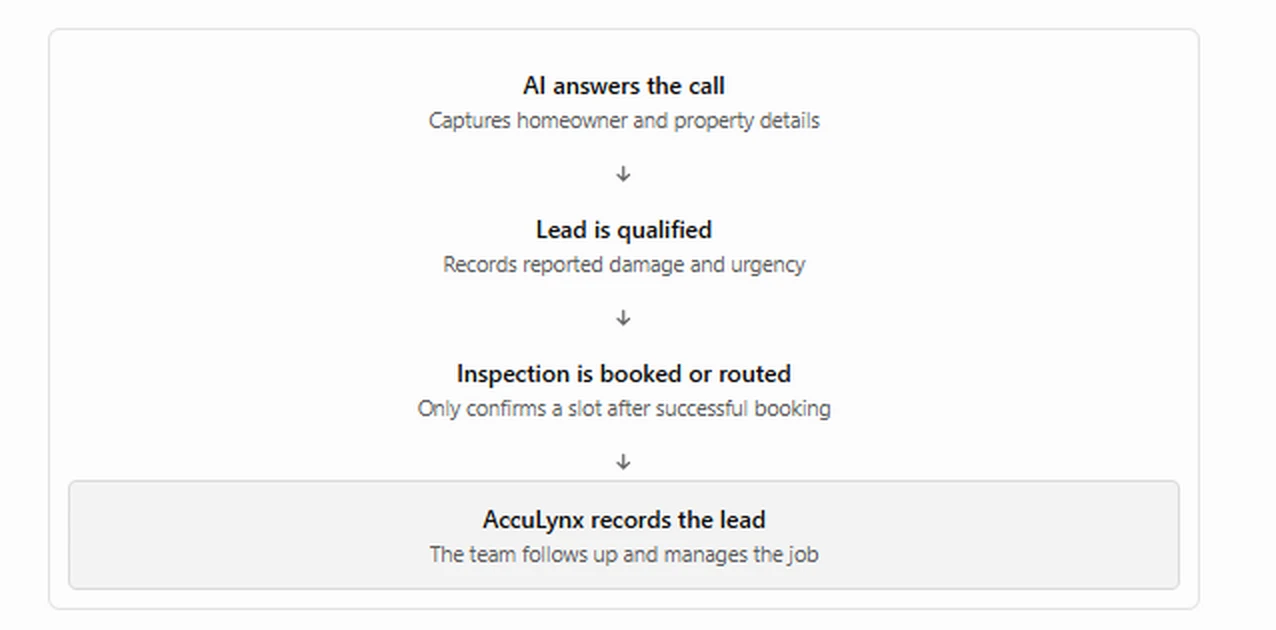
That does not mean the lead cannot reach them. Every completed call fires a webhook carrying the full structured record — name, number, address, reported damage, roof age, carrier and claim status, urgency, the call summary and the booking outcome. From there:
- Zapier connects that webhook to JobNimbus or AccuLynx if the action you need exists on their Zapier app. Create-a-contact usually does; deeper job and scheduling actions vary, so check the specific action before you plan around it.
- The API request tool lets the agent call your own endpoint mid-conversation, which is the route if your office already has an integration layer.
- Native connectors cover Salesforce, HubSpot and Pipedrive with contact and activity sync, for roofers whose sales side runs on one of those.
Test it the only way that proves anything: place a call yourself, then open the record it created. If your staff still have to retype the address, the integration has not removed the work — it has just moved it.
What to Ask for in a Demo
Fifteen minutes is enough, if you spend it on your calls rather than a slide deck.
- Give it a messy call. A caller who is not sure whether it is hail or wind, does not know their roof age, and mentions a leak halfway through. Clean scripted demos prove nothing.
- Interrupt it. Talk over the question. A homeowner standing under a dripping ceiling will.
- Push past the boundary. Ask it whether insurance will cover the roof. It should decline and route you, not guess.
- Make it book. Watch it check a real calendar and confirm only after the slot is held.
- Open the record. Look at what landed in the CRM, field by field, and ask what it would take to put it where you actually work.
Then ask what it costs against your own storm-week call count, and compare it with the gross profit on the jobs you would need to win — not against the headline value of every call you missed.