Close the Gap Between a New Lead and a Licensed Loan Officer
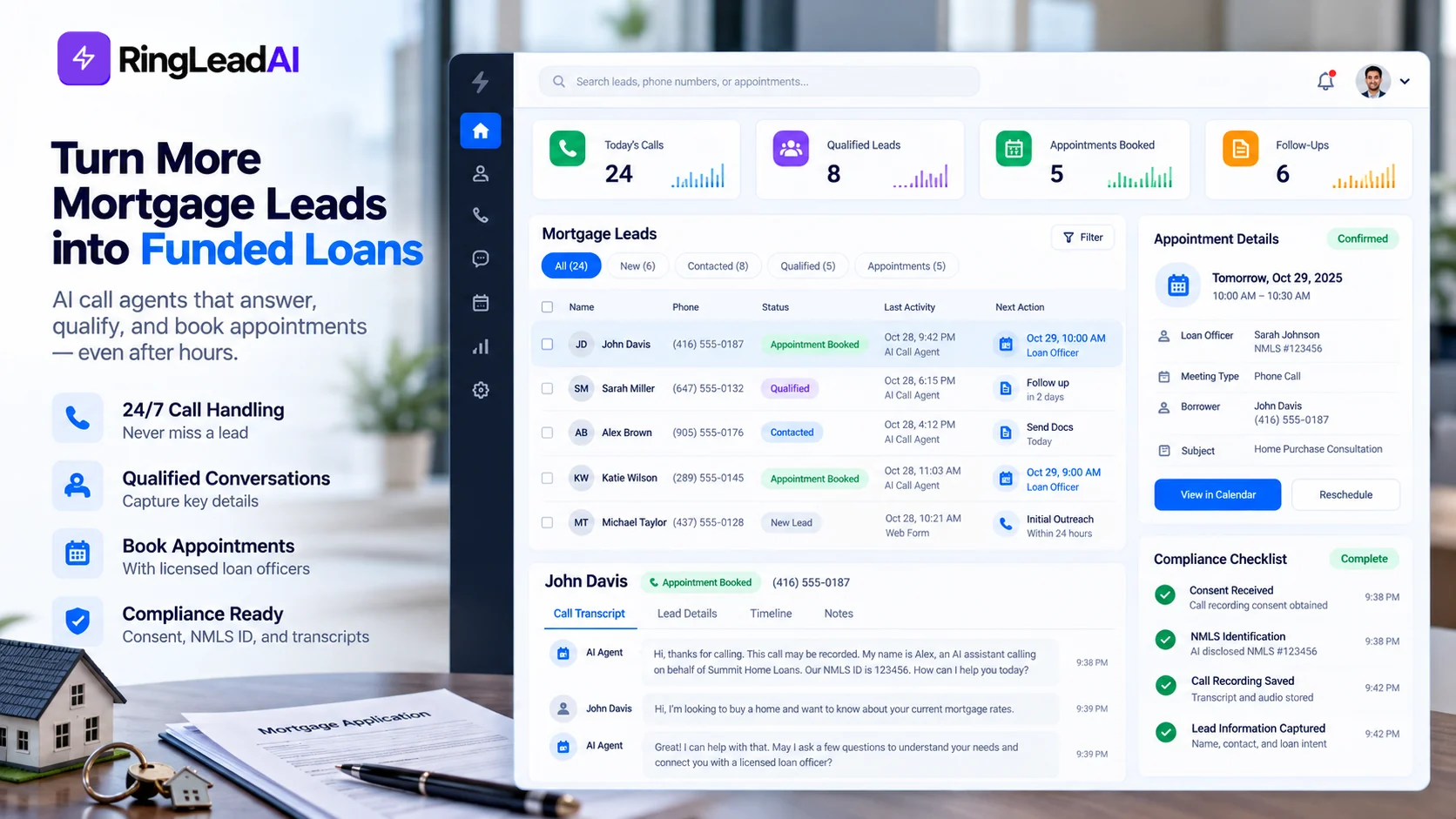
Mortgage leads can arrive at any time, but loan officers cannot answer every call while meeting borrowers, reviewing files, or managing closings. When a new enquiry sits unanswered overnight, the borrower may contact another broker before your team follows up.
An AI call agent helps mortgage brokerages respond to leads, collect approved preliminary information, schedule appointments, and maintain consistent follow-up. It can support inbound enquiries and outbound callbacks, including after-hours coverage, while routing questions about rates, loan terms, and applications to a licensed mortgage loan originator (MLO).
The goal is not to replace the loan officer. It is to reduce the delay between a lead arriving and a qualified professional taking over.
How an AI Call Agent Works for Mortgage Brokers
When a new enquiry arrives, the agent follows an approved workflow to make contact, identify the purpose of the enquiry, gather permitted information, and arrange the next step. A typical workflow:
1. Lead received
A website form, ad campaign, referral, or other source creates a lead — through your CRM sync, a CSV upload, or RingLeadAI's API.
2. First contact
An inbound agent answers enquiries on its own number. For new leads, a workflow that starts “when a lead is created” can place an AI call — only where the call is permitted and within your calling rules.
3. Identification and disclosure
The greeting names the brokerage and its NMLS ID, and the AI and recording announcement tells the borrower they are speaking with an AI assistant.
4. Initial qualification
It asks approved questions about the enquiry, goals, timeline, and preferred contact time — from the knowledge base and prompt your compliance team signs off.
5. Appointment or handoff
It books an available slot on the loan officer's calendar through Cal.com, or transfers the call to a licensed MLO. If nobody answers, it takes a message and texts the details to your team member.
6. Records
Every call's recording, transcript, and summary lands in the Call Library; Salesforce and HubSpot sync natively, and webhooks, Zapier, or the API request tool carry calls to other systems.
7. Follow-up
Follow-up calls run only for leads with the right consent, as voice campaigns with calling hours in the lead's time zone and a Do-Not-Call list — and they stop when a borrower opts out.
Why Slow Lead Response Can Cost You Funded Loans
A lead's value can decline when first contact is delayed. Someone enquiring about a purchase mortgage may be comparing several lenders. A borrower looking to refinance may contact another provider while waiting for a callback.
The problem becomes more noticeable when leads arrive at night, on weekends, or during busy periods, when a loan officer is occupied with existing clients and can't respond immediately.
The lead-response gap
Consider a borrower who submits a purchase enquiry at 9:12 p.m. on Sunday. If your office is closed, the enquiry may remain untouched until Monday morning. Another brokerage with an effective after-hours workflow could make contact sooner and arrange the first available appointment.
That does not guarantee the other brokerage will win the loan. It illustrates why response time is worth measuring — in your own CRM, rather than with the second-hand industry statistics that circulate without their original research.
Why manual follow-up often breaks down
- Loan officers are in appointments, reviewing applications, or handling closings.
- Leads arrive outside staffed hours.
- Voicemails and email reminders do not establish a live conversation.
- Follow-up tasks are missed or recorded inconsistently.
- Managers cannot easily compare response and conversion performance by lead source.
- Repeated low-intent enquiries consume time that could be spent with borrowers ready to speak to an MLO.
An AI call agent can help with the first-contact and follow-up workload. Measure its value by the quality of the handoff and the resulting pipeline, not by the number of calls made.
What You Can Recover: Cost-per-Funded-Loan Calculator
The most useful way to assess an AI call agent is to model your own lead funnel — your lead volume, costs, contact rates, qualification rates, application rates, and funded-loan outcomes — rather than a vendor's conversion claims. The calculator compares your current workflow with a faster-contact workflow on the same lead volume and lead cost:
Funded loans = Leads × Contact rate × Pre-qualification rate × Application rate × Pull-through rate
Cost-per-Funded-Loan Calculator
Example values — replace them with your own figures.
Estimated impact
- Funded loans today
- 18.9 / mo
- Funded loans with faster contact
- 27.3 / mo
- Additional gross commission
- $25,200 / mo
- Cost per funded loan today
- $635
- Cost per funded loan, incl. AI cost
- $447
A scenario, not a forecast: it assumes the later-stage rates stay the same when more leads are reached, and gross commission is not net profit.
Compare the real cost
Compare the AI agent's total monthly cost with an ISA's loaded employment cost and a call center's contract fee, including onboarding, telephony, integrations, management time, and the staffing costs that remain. Average commission is not net profit: account for your actual compensation structure before concluding that an additional funded loan covers the investment.
Mortgage Call Scenarios: How the Agent Handles Real Enquiries
These examples show how an AI call agent can support initial contact while keeping mortgage advice and regulated origination activities with a licensed professional. They are sample scripts, not recordings of actual borrower calls.
Scenario 1: Sunday-night purchase lead
Enquiry submitted Sunday, 9:12 p.m. — the AI assistant calls back promptly, provided the call is permitted and within the applicable calling rules.
“Hi, this is the AI assistant for [Brokerage Name], NMLS ID [number]. I'm calling about the mortgage enquiry you submitted. Is now an okay time to speak?”
“Yes, that's fine.”
“Thank you. I'll ask a few initial questions to help arrange the right conversation. I'm not a loan officer and can't quote rates or approve a loan. Are you looking to buy a home?”
“Yes. We're under contract and need to close in about 30 days. We've spoken to one lender, but we're comparing options.”
“Understood. I can check the licensed loan officer's available times. Would 8:30 tomorrow morning work for you?”
“Yes.”
“You're booked for 8:30 a.m. tomorrow. I'll send a confirmation with the appointment details.”
Your CRM can then receive the lead source, contact outcome, borrower-stated timeline, and appointment, with the call's recording and transcript in the Call Library.
Scenario 2: Inbound rate-shopper
“What's your 30-year fixed rate today?”
“A licensed loan officer needs to review your circumstances before discussing available rates or loan terms. I can't quote a rate, but I can arrange a call. Are you looking to purchase or refinance?”
“I'm buying. I have a home in mind — today, if possible.”
“Thanks. I'll check today's available times with a licensed loan officer.”
The agent should not invent a rate, estimate personalized savings, or promise approval. It routes the borrower to the licensed professional who can review the situation.
Scenarios 3–6: Refinance, first-time buyer, Realtor partner, and reminders
- Refinance enquiry: the agent asks the purpose — a lower payment, cash-out, or removing mortgage insurance — and collects approved routing information. It doesn't calculate savings, recommend a product, or determine eligibility.
- First-time buyer who is “just looking”: it captures the general timeline and offers an introductory call with a licensed MLO. If the borrower prefers to wait, it records that preference; any follow-up runs only with consent.
- Realtor partner call: it captures the purpose of the status request and routes it to the assigned loan officer — without disclosing borrower information or discussing referral compensation.
- Document reminders and database reactivation: once the lead workflow is stable, reminders should point borrowers to your secure upload process rather than collecting sensitive financial details on a call, and reactivation needs a specific approved reason, consent, and opt-out handling. A previous enquiry doesn't authorize every future marketing call.
When you test your own agent, listen for clear brokerage identification, AI disclosure, the appropriate consent process, consistent approved questions, a firm boundary on rates and terms, and a clean handoff to a licensed MLO.
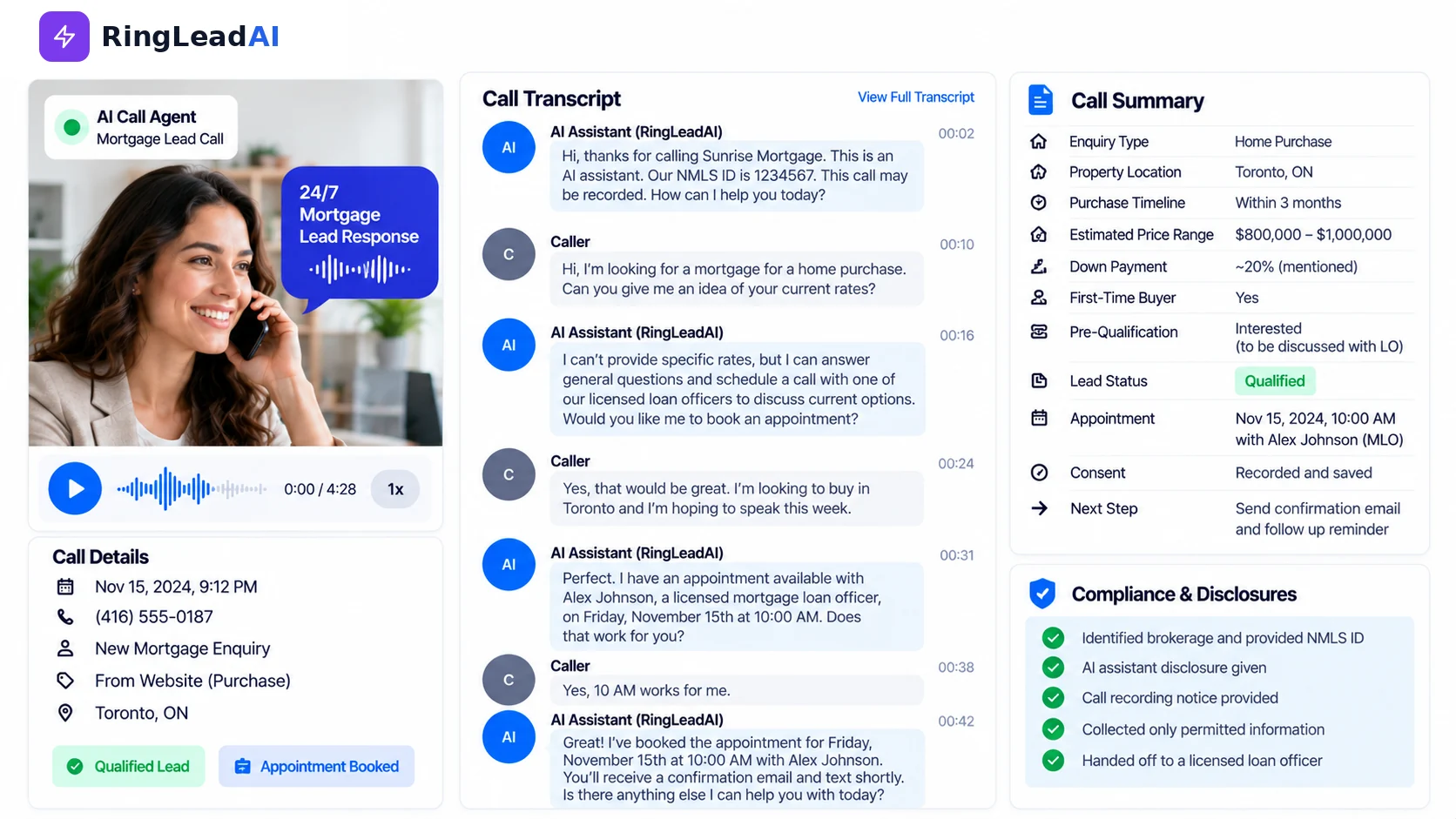
Integrations: Connect the Phone System, CRM, LOS, and Calendar
An AI call agent is most useful when its records reach the systems your team already uses.
What connects in RingLeadAI today:
- CRM: native sync with Salesforce and HubSpot (also Pipedrive and Close).
- Calendar: Cal.com booking during the call, syncing the loan officer's Google Calendar or Outlook.
- Everything else: signed webhooks and Zapier after each call, Slack alerts, the agent's API request tool during the call, and the public API on Scale plans for sending leads in.
Wherever the records land, they should include: lead source and assigned LO; call time and contact outcome; the borrower-stated purpose and timeline; the approved initial qualification summary; appointment status; consent and opt-out records; the recording or transcript link where lawfully retained; and outstanding follow-up tasks. Keep borrower-reported information distinct from verified application data — a call summary is not an application or underwriting record.
Licensing and Compliance: What the AI May Do and What It Must Never Do
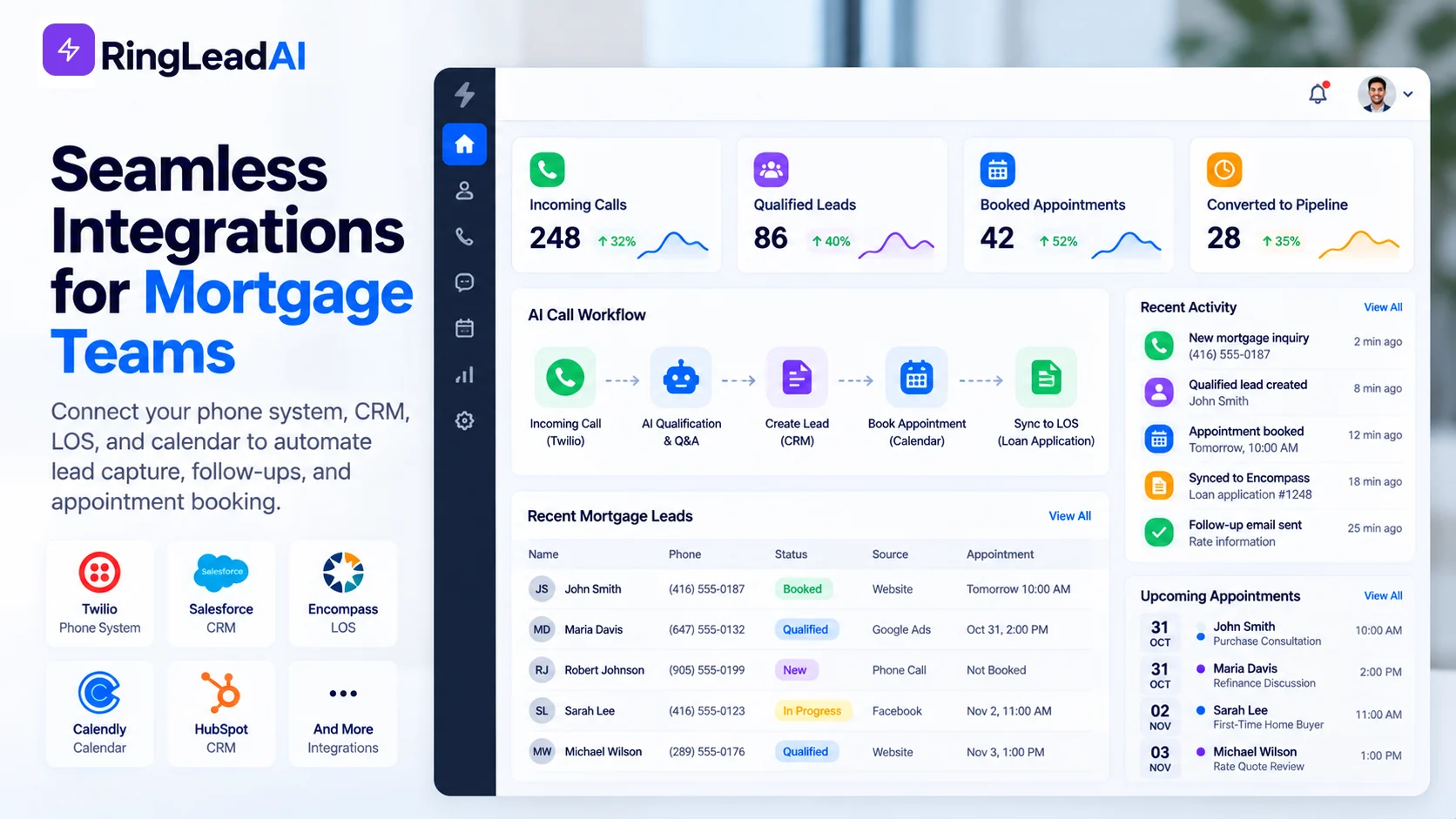
Design the system around the legal boundary between administrative assistance and regulated mortgage origination. Under the SAFE Act framework and applicable state laws, activities such as taking a residential mortgage loan application and offering or negotiating loan terms can require an appropriately licensed MLO. The boundary depends on the conduct and circumstances, not the name of the workflow.
A conservative configuration keeps the AI on identification, scheduling, approved initial routing questions, and administrative follow-up. It should not quote rates or APR, negotiate terms, recommend a specific loan, run credit, make underwriting decisions, or issue pre-approval. Calling a process “pre-qualification” doesn't make every question permissible — have compliance counsel review the actual script, the information collected, and how it's used.
TCPA consent and AI-generated voices
On February 8, 2024, the FCC confirmed that AI-generated voices fall within the TCPA's restrictions on artificial or prerecorded voices. Consent requirements depend on the call's purpose, recipient, technology, and any exceptions; marketing calls can require prior express written consent. The Eleventh Circuit vacated the FCC's one-to-one consent rule for lead generators in January 2025 — which did not remove the underlying TCPA consent requirements.
Review lead-form language, aggregator terms, the business named in the consent, and the intended use of automated calls and texts with qualified counsel. The workflow should support:
- Consent records with source and timestamp.
- Calling hours based on the borrower's time zone (RingLeadAI's voice campaigns apply them).
- Opt-outs and suppression — a Do-Not-Call list.
- Channel-specific permissions: consent for calls doesn't automatically cover texts.
- Recording disclosures and retention rules.
- Review of state-specific requirements.
NMLS identification, fair lending, and UDAAP
Put the brokerage's approved name and NMLS ID in the agent's greeting. Scripts should use consistent, approved questions and avoid prohibited questions, discriminatory steering, or unsupported claims. The agent should never promise approval, a specific rate, or guaranteed savings; answers come from an approved knowledge base, and unsupported questions go to a person.
Call recording, GLBA, and data retention
Recording laws differ by state, so don't assume one-party consent covers every call — the agent's AI and recording announcement plays before the greeting. Review who can access recordings and transcripts, where data is stored, how long it's kept, and how deletion requests are handled; GLBA safeguards and other privacy obligations may apply to borrower information. RingLeadAI does not hold a SOC 2 report and publishes its sub-processor list.
Compliance launch checklist
- Get counsel and compliance approval for scripts and qualification fields.
- Verify lead-source consent, aggregator terms, and applicable calling restrictions.
- Configure opt-outs, the Do-Not-Call list, and calling hours.
- Put the brokerage name and NMLS ID in the greeting; turn on the AI and recording announcement.
- Review fair lending, UDAAP, recording, privacy, and retention requirements.
- Test rate questions, requests for a human, unsupported questions, and opt-outs.
- Review transcripts regularly for script drift and missed escalations.
- Know how to stop everything at once: pause every campaign and workflow.
This is general information, not legal advice. Have qualified compliance counsel review the actual workflow before launch.
Pricing and Plans
Compare providers on the total cost of the workflow, not only the advertised subscription: included minutes, outbound usage, telephony, onboarding, integrations, support, branch coverage, and contract length.
| What to check | RingLeadAI today |
|---|---|
| Plans and included usage | Voice Starter $49/mo (200 voice minutes), Voice Pro $199/mo (1,000 voice minutes), Voice Scale $499/mo (3,000 voice minutes) |
| Inbound and outbound | Inbound agents on their own numbers; outbound voice campaigns and lead-triggered workflow calls |
| Calendars | Cal.com booking per loan officer, syncing Google Calendar or Outlook |
| CRM and LOS | Salesforce and HubSpot native; LOS and mortgage CRMs through webhooks, Zapier, or the API request tool |
| Languages | One per agent, 16 available including Spanish |
| Terms | 7-day free trial, no credit card, cancel anytime |
Current plans and terms are always on the pricing page. Measure payback in funded loans: include setup and ongoing costs, and don't treat gross commission as net profit.
Measure It Yourself: Before-and-After Metrics
The strongest evidence is your own. Compare a defined period before implementation with a comparable period after — 90-day windows where possible — and note changes in lead volume, source, staffing, or marketing spend.
| Metric | Define it as |
|---|---|
| Lead volume by source | Verified count per source |
| Median time to first contact | Measured from lead creation |
| Contact rate | Leads reached ÷ leads received (a reach, not a meaningful conversation) |
| Pre-qualification rate | Leads passing your approved questions |
| Appointments kept | Attended, not just booked |
| Applications taken | Verified count |
| Funded loans | Over a period that reflects your sales cycle |
| Cost per funded loan | Total lead and system cost ÷ funded loans |
| LO hours on first contact | Measured hours |
Common Objections About Mortgage AI Call Agents
- “An AI can't talk to borrowers without a license.” What matters is what the system does. Administrative first contact and scheduling may be suitable for automation; activities requiring an MLO must stay with a licensed professional. Have counsel review the actual workflow.
- “It will quote a rate or promise an approval.” Use an approved knowledge base and explicit boundaries for rate, APR, eligibility, and loan-term questions, with a handoff to a licensed MLO. Review transcripts in the Call Library and keep a way to pause the system.
- “Outbound AI calls will get us sued.” No vendor can guarantee a calling workflow is free from legal risk. Review consent, lead-source agreements, calling hours, opt-outs, suppression lists, and recording requirements with counsel before launch.
- “Borrowers want a human for the biggest purchase of their life.” They should have one for the loan conversation. The AI makes timely contact, confirms the enquiry, collects permitted routing information, and arranges the conversation — with a clear way to ask for a person.
- “My loan officers won't use it.” Give LOs concise appointment summaries, contact history, lead source, borrower-stated goals, and next steps, with unverified information clearly marked.
AI Call Agent vs. ISA, Call Center, Loan Officers, and Drip Email
| Feature | AI call agent | ISA or call center | Loan officers working leads | Drip email and voicemail |
|---|---|---|---|---|
| First-contact speed | Rapid, including after hours, when configured | Depends on staffing and queues | Depends on LO availability | Email sends fast but isn't a live contact |
| Initial qualification | Consistent approved questions and routing | Script-based; depends on training | Professional judgment once connected | Limited interaction |
| Licensing boundary | Must stop before activities requiring an MLO | Unlicensed staff face similar limits | Licensed MLO can perform permitted origination | No live origination conversation |
| Consent controls | Calling hours, Do-Not-Call list, recorded calls | Depends on dialer and procedures | Depends on process | Separate email permissions |
| System logging | Recording, transcript, summary; CRM sync where connected | Manual work or integration | Depends on the LO's workflow | Campaign engagement data |
| Cost model | Subscription — see pricing | Salary or vendor fee, training, management | Staff time and opportunity cost | Lower direct cost; no live contact |
An AI call agent isn't automatically cheaper or more effective in every brokerage. A hybrid often fits best: AI handles permitted first contact and scheduling, while licensed MLOs focus on advice, applications, and loan decisions.
Start With After-Hours Callbacks
An AI call agent can help mortgage brokerages respond to enquiries promptly, maintain follow-up, and prepare more organized handoffs to licensed loan officers. Judge it by the outcomes that matter: appointments kept, applications taken, funded loans, and cost per funded loan.
Start with after-hours callbacks, measure performance, and expand to inbound overflow, document reminders, or database reactivation only after the first workflow has been tested.