A Name on a List Is Not a Lead
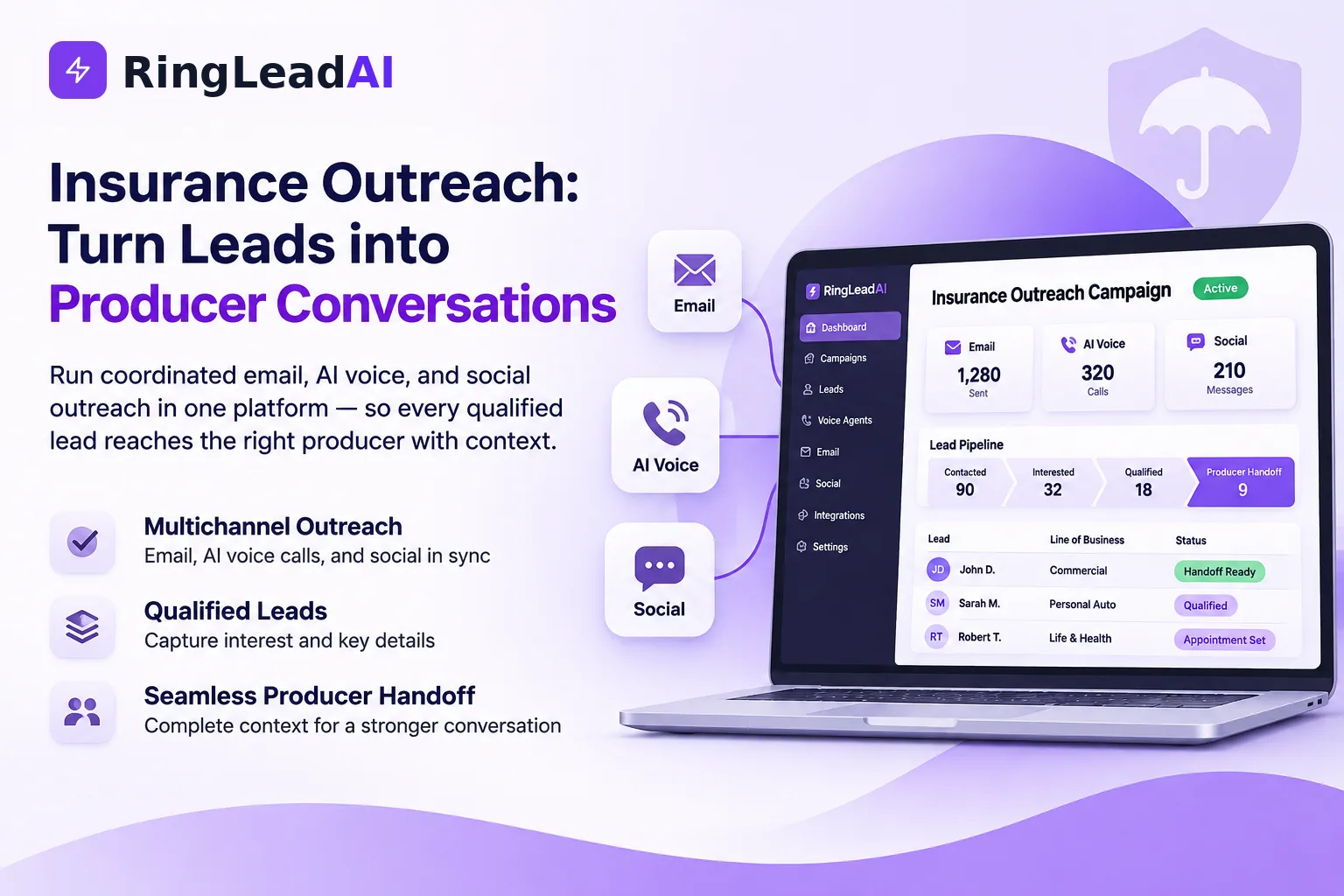
Prospecting that runs in bursts leaves producers holding a pile of names and a few notes. None of it tells them who actually asked about the line, what they said, or what happens next.
The symptom is familiar: a producer works through a handoff sheet and spends the morning calling people who never asked about the coverage someone flagged. That happens when email and calling run as separate jobs, so the context never travels with the lead.
RingLeadAI runs email, AI voice calls and social touchpoints from one dashboard. A reply on one channel stops the others, so a prospect who answers the email does not also get a call about the same message.
Who This Fits, and the Boundary That Holds Whatever the Tool
This workflow suits agency owners, independent brokerages and sales leaders who already understand prospecting and want a cleaner path from first contact to producer handoff — a qualified callback on commercial coverage, a quote-review appointment for personal auto and home, or a life and health conversation with someone who has actually expressed interest.
One distinction comes before anything else is built. Outbound prospecting initiates contact with a defined audience. Intake responds to incoming enquiries. This page plans outbound only.
Personal auto and home, life and health, and commercial are separate scope categories. Each needs different messaging, different qualification criteria and different handoff expectations. The agency defines which one a campaign is for before the first send.
Define the Campaign Before Any Outreach Begins
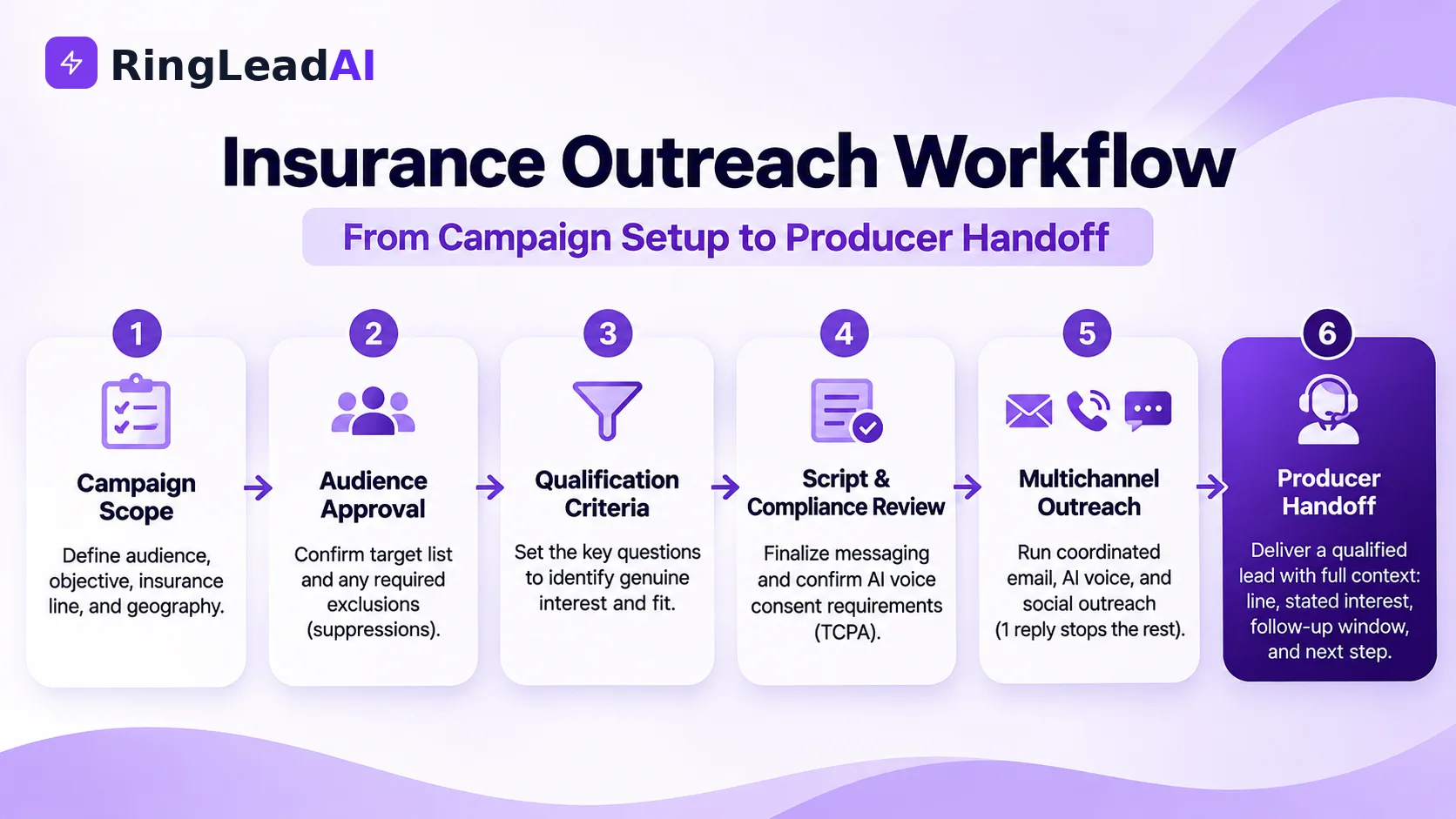
Six inputs settle before the first call, and leaving any of them open is how a campaign ends up being judged against a standard nobody agreed:
- Line and audience. What coverage you are opening, and who you are contacting.
- Geography and source. Where prospects are, and where the list came from.
- One primary objective. A qualified conversation with an agreed next step — not a dial count or a connect count.
- Fit criteria and qualification questions. What decides whether a conversation counts.
- Approved script and escalation route. Including where a coverage question goes the moment it is asked.
- A named agency contact. Who owns script changes and receives the handoffs.
Personal and commercial scripts differ — different questions, different objections, different producers. One script for both blurs the qualification and makes the reporting meaningless.
Put list screening and the suppression workflow into launch scope rather than treating them as cleanup. A written suppression rule — one request stops outreach everywhere — is what makes every dial defensible afterwards.
The Seven Fields a Producer Actually Needs
The campaign's output is a handoff. Everything scoped upstream only matters if the producer receives enough context to act without redoing the conversation.
“Interested in insurance” is a dead end. A producer cannot act on it. Seven fields, in the order a producer reads them:
- Contact. Who the prospect is, with usable details.
- Line. The coverage they asked about.
- Stated interest. In their words, not a category.
- Qualification answers. The responses that cleared the agreed criteria.
- Follow-up window. When they agreed to be contacted.
- Agreed next step. What both sides said would happen.
- Summary. A tight recap of the conversation.
The difference is concrete. An incomplete handoff reads: “Jane, 555-0100, interested in insurance, follow up.” The producer has to call, rediscover the line, re-qualify, and hope the moment is still warm. A complete one reads: “Jane, commercial property, renewal anxiety after a fire next door, clears the revenue floor, wants a ten-minute call Thursday 9:30, agreed to send her declarations page.”
One is a task. The other is a conversation already half finished. Both examples are illustrative rather than client records.
Where a producer takes a live warm transfer, the agent briefs them before connecting, so the handoff starts with the conversation's context instead of a reconstructed note.
Reporting That Separates Motion From Opportunity
Dials and contacts show motion. Qualified leads and appointments show whether the handoff was useful. Campaigns lose the thread when activity metrics are reported as though they were pipeline.
A planning scorecard. Every rate below is an assumption to replace with your own. None of it is a RingLeadAI benchmark, and none of it is a forecast:
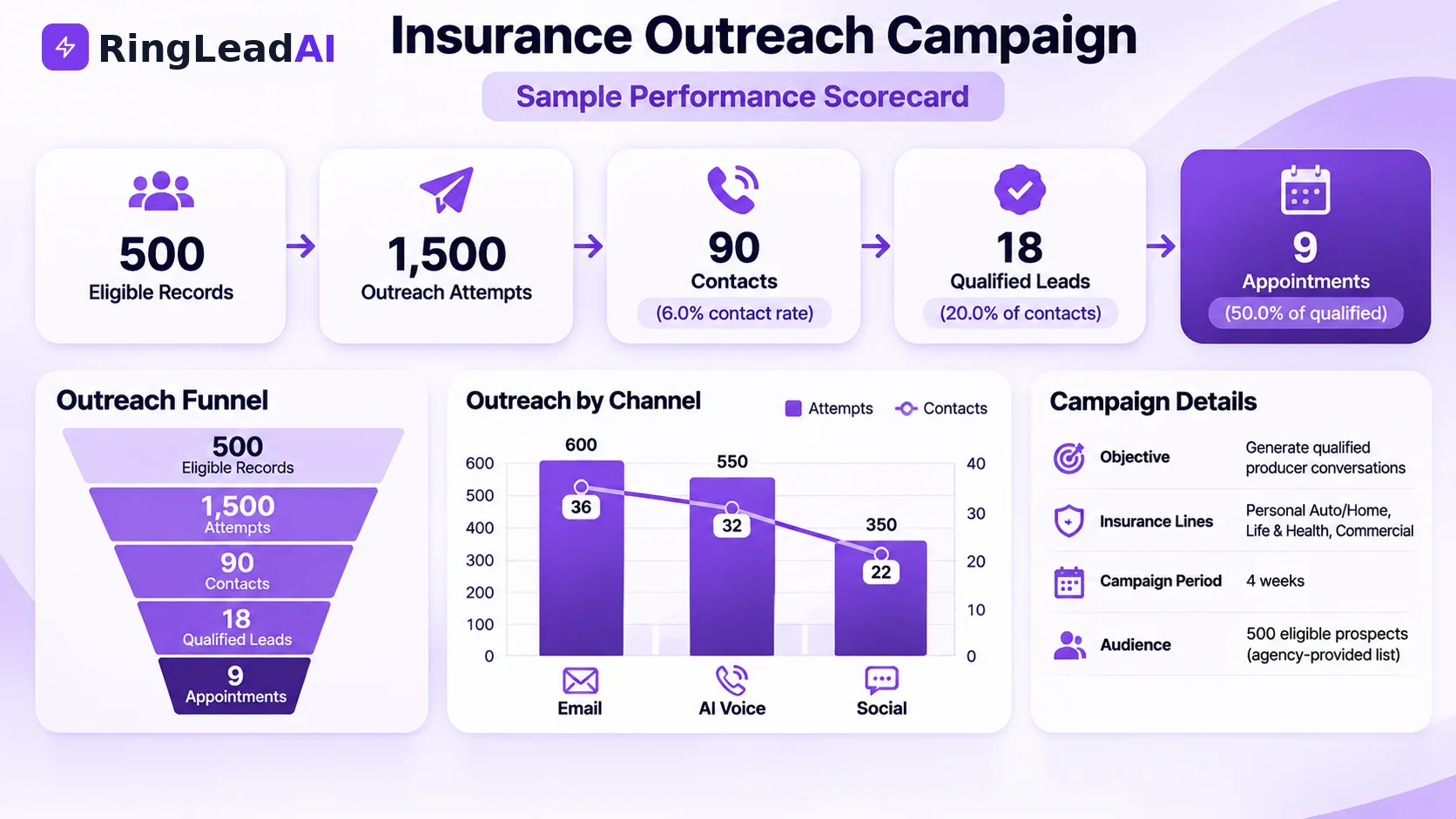
| Measure | Illustrative input | What it tells the agency |
|---|---|---|
| Eligible records | 500 | Size of the agreed audience |
| Attempts per record | 3 | Planned touch frequency |
| Total attempts | 1,500 | Volume of outreach motion |
| Contact rate | 6% | Whether the list and script reach people |
| Contacts | 90 | Conversations actually initiated |
| Qualification rate | 20% | Whether the conversation qualifies |
| Qualified leads | 18 | Handoffs a producer can act on |
| Booking rate | 50% | Whether the next step is accepted |
| Appointments booked | 9 | Agreed next steps secured |
Within the outcome group the distinctions matter: an appointment booked differs from an appointment held, a client-accepted lead differs from both, and none of them equals a policy sale.
Responsible Outreach and Clear Role Boundaries
The measures only mean something if the outreach itself is lawful, accurate and stays inside its role. A clean producer handoff starts before the first dial: the agency owns the contact records, the permission records, every suppression request and the jurisdiction review.
- Screen the list. Scrub against the National Do Not Call Registry and applicable state lists, and observe legal calling windows.
- Write the suppression workflow down. One opt-out request stops outreach on every channel, not just the one it arrived on.
- Treat consent as a precondition, not a cleanup task. Prior express consent for AI-generated voice calls cannot be backfilled after a complaint arrives.
- Route coverage questions immediately. A caller who answers a coverage question on the line has crossed the licensed-professional boundary. For life and annuity products, the disclosure requirements before a quote make that crossing expensive.
A truthful opening names the campaign's purpose in plain words: who is calling, on whose behalf, and why. Questions stay tied to the agreed objective. Every recommendation or quote request gets an approved route to the producer's calendar rather than an improvised answer on the call.
Change control belongs to the agency: it identifies the wording change, approves the exact language, and confirms when the revised script goes live.
A Small, Measurable Way to Test Fit
A short run tests the whole framework without a long commitment. Seven terms, as a working draft:
- One audience. A defined segment, not the whole book.
- One objective. A single line or referral request, not a menu.
- Approved script and lead definition. Agreed before dialling.
- A written contact and suppression workflow. Including consent and opt-out handling.
- A two-week operating period. Long enough to test the workflow.
- A weekly quality review. Of the producer handoffs, against the six-item rubric.
- A closeout summary. What to keep, fix or drop.
The two weeks test workflow, consent handling and usable handoffs. The call volume it produces is a byproduct, not the success metric.
A short readiness check: if your goal, audience, lead source and preparation are all written down and agreed, you are ready to scope. If the audience and goal are clear but the lead definition is fuzzy, define what makes a lead useful first. If the contact workflow or consent steps are missing, review them with a compliance lead before anything dials. This is planning guidance, not legal advice.