Why Manual Cold Calling Stops Scaling
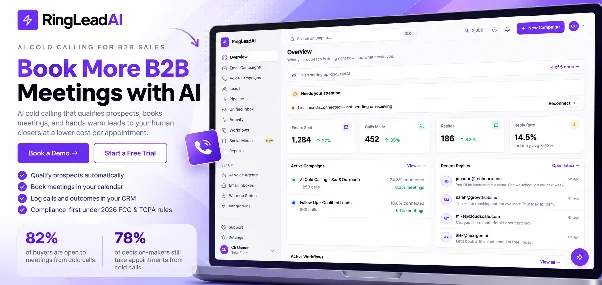
Cold outreach remains one of the fastest routes to pipeline, but relying solely on manual rep-driven calling makes scaling cost-prohibitive. Low connect rates mean many dials for every conversation, and human SDR costs keep climbing with ramp time, churn, and quota inconsistency.
AI Cold Calling shifts the unit economics.
RingLeadAI automates outbound dialing, qualification on the call, calendar booking, and CRM syncing. Your sales team gets a calendar of qualified opportunities without burning hundreds of manual calling hours.
This practical guide breaks down how AI cold calling works, where it fits, what it costs to run, and how to execute a controlled pilot that measures ROI.
What Is AI Cold Calling for B2B Sales?
Definition and Core Concept
AI cold calling combines low-latency Speech-to-Text (STT), Large Language Models (LLMs), and realistic Text-to-Speech (TTS) over real-time audio streams (SIP/WebRTC) to run dynamic, two-way outbound phone conversations — without requiring human SDRs to dial or speak.
Unlike brittle IVRs or static soundboard systems, conversational voice AI interprets complex prospect answers, adjusts to tone, counters objections, and books into your calendar to confirm qualified meetings on the fly.
AI Cold Calling vs. Traditional Dialers
| Feature | Legacy Power / Parallel Dialers | Conversational AI Calling (RingLeadAI) |
|---|---|---|
| Primary Function | Speeds up physical dialing; routes answered calls to live reps. | Carries the end-to-end qualification and booking conversation. |
| Rep Dependency | A human rep speaks on every live connect. | No rep time needed until the meeting is booked or a transfer is requested. |
| Conversation Consistency | Limited by rep stamina, pitch fatigue, and human error. | The same qualification criteria on every call. |
| Data Logging | Manual wrap-up notes; inconsistent CRM updates. | Recording, transcript, summary, and sentiment for every call; outcomes synced to your CRM. |
Traditional dialers merely accelerate connections; voice AI manages the dialogue, so your account executives only step in when high-intent opportunities are secured.
The Underlying Technology Stack & the Latency Budget
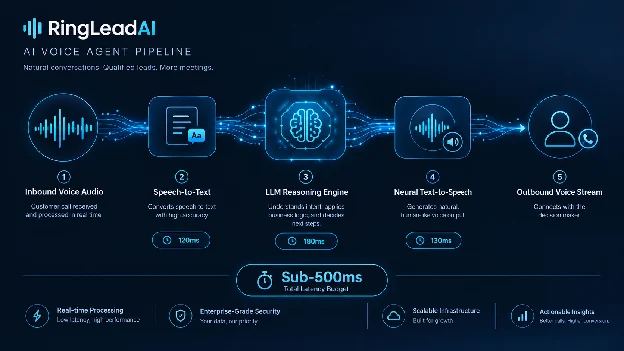
A human-like conversational experience depends on shaving milliseconds off every step in the pipeline. When the turnaround delay creeps up, awkward interruptions occur and hang-ups spike.
A high-performing voice architecture operates across four distinct stages:
- Speech-to-Text (STT): Continuous audio streaming that transcribes the prospect as they speak.
- LLM orchestration: Fast-inference reasoning that decides what to say next, within your prompt's guardrails.
- Text-to-Speech (TTS): Low-latency neural voice synthesis that starts speaking as soon as the reply begins.
- Telephony & transport: Real-time audio over the phone network, with jitter handled along the way.
Why 2026 Is the Tipping Point for Outbound AI
Voice AI adoption has surged due to two simultaneous shifts: far more natural voice synthesis and intensified regulatory enforcement.
- Natural-sounding voices: Lower latency and better emotional inflection make AI conversations far more natural than the robocalls buyers remember.
- Regulatory compliance: Since the FCC declared AI-generated voices subject to the Telephone Consumer Protection Act (TCPA), outbound teams need automated safeguards. RingLeadAI provides:
- An AI and recording announcement at the start of the call — one switch per agent.
- A Do-Not-Call list for numbers that must never be called.
- Calling windows: calls only go out inside the campaign's calling hours, in each lead's own time zone.
For B2B revenue teams, AI voice agents don't replace salespeople — they eliminate the repetitive, low-conversion grind, so human closers can focus on closing pipeline.
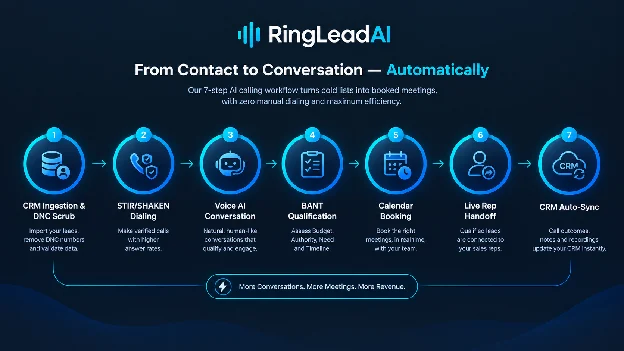
How AI Cold Calling Works: The 7-Step Workflow
RingLeadAI turns chaotic outbound dialing into a predictable qualification and booking engine. Here is the operational architecture from data ingestion to pipeline creation.
Step 1: List Hygiene & Consent Verification
Campaigns begin with CRM leads or a clean CSV. Before a single call is placed, check every record against:
- The National Do-Not-Call Registry and your internal Do-Not-Call list (kept in RingLeadAI).
- Mobile vs. landline status, to stay within TCPA rules for automated calls.
- B2B consent and opt-in status.
Step 2: Phone Numbers & Caller ID Reputation
Calls go out from phone numbers you buy in RingLeadAI and assign to an agent. To protect answer rates:
- Register branded caller ID (CNAM) and confirm STIR/SHAKEN attestation with your carrier where available.
- Watch answer rates per number for signs of spam labelling, and retire numbers that drop.
Step 3: Context-Aware Voice Engagement
Instead of blasting generic audio pitches, the agent opens with context from your lead data — industry pain points, role, or a recent trigger.
- Replies arrive quickly enough to preserve conversational cadence, and the agent yields when the prospect interrupts.
- Prompt it for the usual speed bumps — “I'm in a meeting,” “Send an email,” “Who is this?” — so it handles them without breaking character.
Step 4: Rule-Based Qualification & Dynamic Objection Handling
The voice agent works through your chosen qualification framework (e.g., BANT, MEDDIC, or custom criteria):
- Validates company fit, tech stack, decision-maker authority, and timelines.
- Counters objections using the guardrails in your prompt.
- Politely disqualifies out-of-market leads, keeping your team's calendar clear.
Step 5: Calendar Booking & Instant Confirmation
Once an opportunity meets your qualification thresholds, the agent checks live availability through your Cal.com calendar (which sits on Google or Outlook):
- Secures a confirmed time slot while the buyer is engaged on the phone.
- Cal.com sends the calendar invitation and reminders at once, and the agent can text a confirmation with the Send SMS tool.
Step 6: Live Transfers & Human Closer Handoffs
Complex deals require human relationships. When a prospect is ready, the agent hands over:
- Blind transfer: Sends the caller straight to the destination; a phone destination gets a text with the caller's details as it rings.
- Warm transfer: Holds the caller, calls your team member, briefs them, and connects both. If nobody answers, the agent takes a message and texts your team member the caller's details.
Step 7: Post-Call Intelligence & CRM Sync
When the call ends, every artifact is saved and synced:
- Audio recording and full transcript in the Call Library.
- An AI summary, the call outcome, and sentiment for each call.
- Call outcomes synced to Salesforce, HubSpot, Pipedrive, or Close.
Core Capabilities of an AI Cold Calling Engine
Feature checklists alone do not book meetings. High-converting voice systems combine natural voices, reasoning guardrails, and systems integration.
1. Conversational Voices & Interruption Handling
- Barge-in: The agent stops talking when the prospect speaks, avoiding the “talking over each other” of low-tier bots.
- Natural voices: Choose from a large voice library across genders, accents, and languages — or clone your own voice.
- Natural cadence: Short acknowledgements (“Got it,” “Understood”) and pauses keep the conversation human-paced.
2. Contextual Objection Handling with Guardrails
Rather than brittle decision trees, the agent works from a prompt with clear boundaries:
- Prepared rebuttals: Responses for standard friction points (“Send me an email,” “We already use a competitor,” “No budget until next quarter”).
- Deflection to qualification: Turning pushback into discovery questions rather than defensive arguments.
- Halting boundaries: Instructions not to invent pricing, features, or roadmap commitments — and to hand over instead.
3. CRM Synchronization
- Salesforce: Leads pushed as Salesforce Leads; call outcomes land as Tasks.
- HubSpot, Pipedrive, and Close: Contacts and activity stay in sync.
- Workflow alerts: A Slack message or lead-status update can follow any call outcome.
4. Human Handoff Protocols
AI qualifies; humans close. The handoff supports two pathways:
- Live warm transfer: The agent briefs your rep on the caller and the reason before connecting them.
- Booked discovery: When a live handoff isn't needed, the meeting is booked with the context in the call record.
5. Personalization at Scale
Relevance drives pickup-to-qualification rates. The agent uses your lead data — first name, company, role, and custom fields — to deliver factual, non-intrusive openers, and your prompt keeps it away from outdated or overly familiar details.
Buyer's Evaluation Matrix: How to Audit an AI Voice Provider
Before committing to a multi-seat rollout, audit prospective platforms against these production-grade questions:
| Evaluation Dimension | What Most Vendors Offer | What Teams Should Demand |
|---|---|---|
| Latency Measurement | Component-only stats (e.g., "fast TTS"). | End-to-end latency measured on real phone calls. |
| Barge-In Capability | Waits for full sentence completion before stopping. | The agent stops immediately when interrupted. |
| Compliance Safeguards | Basic Do-Not-Call file uploads. | Calling-hour windows, a maintained Do-Not-Call list, and AI disclosure. |
| Telephony Reputation | Shared outbound number pools. | Dedicated numbers with registered caller ID. |
| Data Synchronization | Manual CSV exports or raw webhook dumps. | Native CRM sync of call outcomes. |
Benefits and Measurable Unit Economics
Scaling outbound pipeline is fundamentally a math problem. When sales development relies solely on manual labor, customer acquisition costs rise alongside headcount. Voice AI shifts repetitive dialing and early discovery into an automated asset.
Unit Economics: Human SDR vs. AI Voice Agent
To evaluate true return on investment, measure total fully-loaded costs against downstream pipeline:
| Metric | Traditional SDR In-House | AI Voice Calling (RingLeadAI) |
|---|---|---|
| Fully-Loaded Cost | Base, OTE, benefits, and tech stack | Platform, usage, and telephony |
| Cost Per Booked Meeting | Your current baseline | Measure in a controlled pilot |
| Daily Call Capacity | Limited by working hours | Calls in parallel, within the agent's concurrency |
| Execution Consistency | Degrades with fatigue, script drift, and ramp time | Follows your prompt and qualification rules on every call |
| CRM Admin Burden | Manual notes after every call | Recording, transcript, and summary saved automatically |
1. Lower Cost Per Booked Meeting
Traditional SDR models inflate acquisition costs once you factor in recruiting, management overhead, multi-month ramp periods, and turnover. AI calling takes those costs out of the top of the funnel. Even after platform fees and telephony rates, the savings let revenue teams reinvest in lead sourcing and customer retention.
2. Connect Rates Driven by Smart Calling
Connect rates for cold outbound depend on list freshness and title seniority. Improve them with:
- Calling hours: Calls go out inside the hours you set, in each lead's own time zone.
- Clean caller ID: Registered, dedicated numbers instead of shared pools.
3. High-Quality, Filtered Pipeline (Not Just Vanity Bookings)
More meetings are useless if Account Executives spend their time disqualifying tire-kickers. The agent enforces non-negotiable criteria (tech stack, budget threshold, seat count) before sending a calendar invite, and disqualified prospects are politely exited with the outcome recorded.
4. Reclaiming Human Rep Selling Time
When SDRs are freed from dialing, dial tones, voicemails, and call notes, their focus shifts to high-value revenue drivers:
- Account-based research for Tier-1 enterprise targets.
- Deep-dive discovery and product demonstrations.
- Multi-threading deals and overcoming late-stage contract stalls.
5. Elastic Pipeline Scaling
Human hiring requires weeks of sourcing and onboarding. AI calling scales with demand:
- Ramp outreach to thousands of accounts during product launches or end-of-quarter pushes.
- Scale back immediately without payroll liabilities or severance costs.
6. Script Adherence & Rapid A/B Testing
When human reps struggle with an objection, they often improvise or skip core qualification steps. An AI agent delivers your value proposition the same way on every call — and when you change a hook or rebuttal in the agent's prompt, the next calls use it.
Benchmarking Methodology: Measuring True Downstream ROI
Never evaluate cold outbound on raw call volume. Track these four metrics:
- Answer rate: Connected calls divided by total dialed records.
- Conversation-to-qualified rate: Prospects who pass all qualification filters divided by total live connects.
- Meeting show rate: Attended appointments divided by scheduled appointments.
- Opportunity pipeline generated: The dollar value of pipeline created from AI-booked meetings.
A controlled pilot lets you compare these ratios against your historical rep baselines before scaling.
High-Impact Use Cases & Strategic Fit
Deploying conversational voice AI is not about replacing your top account executives; it is about automating where repetitive manual execution drains team productivity.
1. Instant Inbound Lead Qualification ("Speed-to-Lead")
When a prospect fills out a demo request or downloads a high-intent asset, minutes matter — reaching a lead within the first few minutes beats delayed manual outreach.
- Automated outreach: A workflow calls opt-in inbound contacts as soon as they arrive.
- Rapid qualification: Validates company size, role, and immediate pain points against BANT or MEDDIC.
- Direct handover: Books qualified buyers on a closer's calendar or warm-transfers them live.
2. Re-Activating Stalled & Closed-Lost Databases
Most B2B CRMs hold thousands of cold contacts, past evaluation drop-offs, and unresponsive leads from 6–12 months ago that reps rarely have time to re-contact.
- Pipeline mining: Re-engage historical leads to find new budget cycles, leadership changes, or shifting vendor priorities.
- Database hygiene: Confirm who is still reachable and record outcomes, without burning rep hours.
- Compliance safeguard: Re-check aged records against Do-Not-Call lists before dialing.
3. Outbound Appointment Setting for Human Closers
High-velocity cold outreach requires volume and resilience that burn out human SDRs.
- Top-of-funnel filtering: The agent runs initial discovery, fields repetitive objections, and books calendar slots.
- Contextual briefing: Account Executives get the transcript, summary, and qualification answers before stepping into the discovery call.
Deployment Suitability Matrix: Where to Deploy (and Where Not To)
Voice AI excels at high-velocity, structured processes; complex, high-touch sales still require human nuance.
| Scenario | Strategic Fit | Operational Reason |
|---|---|---|
| High-Volume B2B Qualification | Optimal | Structured criteria, repeatable talk tracks, high daily call requirements. |
| Speed-to-Lead Inbound Response | Optimal | Fast engagement when buyer intent is at its peak. |
| Event / Webinar Follow-Ups | Optimal | Consistent qualification across hundreds of attendees at once. |
| Enterprise Multi-Stakeholder Deals | Sub-Optimal (Use Humans) | Requires organizational navigation, political alignment, and deep technical discussions. |
| Complex Contract & Pricing Negotiations | Not Recommended | Commercial compromises and emotional intelligence demand senior human closers. |
Tech Stack & Integrations
An AI calling agent is only as effective as the infrastructure behind it. RingLeadAI connects your phone numbers, agents, CRM, and calendar so calls don't create data silos.
1. CRM: Salesforce, HubSpot, Pipedrive & Close
- Salesforce: Leads pushed as Salesforce Leads; call outcomes and replies land as Tasks.
- HubSpot: Native CRM sync — contacts and activity flow into HubSpot.
- Pipedrive and Close: People, activities, and call outcomes stay in sync.
- Alerts: Workflows can post to Slack when a meeting is booked.
2. Calendar Booking
- Cal.com: The agent checks live availability during the call, respecting your buffers, and books without double-booking.
- Time zones: Cal.com handles the prospect's local time zone, avoiding scheduling confusion.
- Confirmations: Invites and reminders go out immediately to protect show rates.
3. Phone Numbers & Calling Controls
- Buy phone numbers in the app and choose which agent answers each one.
- Set calling hours per campaign; calls follow each lead's own time zone.
- Calls run in parallel, governed by the agent's concurrency.
4. Voices & Languages
Pick from a large voice library — filtered by gender, accent, and language — or clone a voice from a short sample. Agents can speak and listen in 16 languages.
5. Compliance Controls
- Do-Not-Call list: Keep an internal Do-Not-Call list, and screen against the National and State registries before uploading lists.
- AI and recording announcement: Turn it on per agent so every call opens with a short disclosure.
- Opt-outs: An opt-out suppresses the lead across email, voice, and social.
6. Call Review & Live Monitoring
- Live Calls: Watch calls as they happen and listen in on one in progress.
- Call Library: Every completed call with its recording, transcript, summary, sentiment, and outcome.
- Continuous improvement: Review transcripts weekly to refine prompts and rebuttals.
Compliance & Regulatory Guardrails
Scaling outbound voice requires legal hygiene. RingLeadAI builds the controls into the product; you remain responsible for how your agents call people.
The Regulatory Landscape: TCPA, FCC & State Enforcement
The FCC's rulings classify synthetic and AI-generated voices under the Telephone Consumer Protection Act (TCPA). Navigating this environment demands technical and process controls:
- Mixed-use and mobile numbers: B2B calls have no exemption if numbers map to personal wireless or mixed-use mobile devices. Check line type before calling.
- Consent records: Keep auditable consent records (source, timestamp, and the disclosure text shown).
- Two-party recording consent: For calls into all-party consent states (e.g., California, Florida, Massachusetts, Pennsylvania), turn on the agent's recording announcement so it plays in the opening turn.
- STIR/SHAKEN: Work with your carrier so your numbers are signed and attested, protecting caller ID from spam tagging.
Do-Not-Call & Opt-Out Handling
- Registry and internal lists: Filter lists against the National Do-Not-Call Registry and state registries, and keep your own Do-Not-Call list in RingLeadAI.
- Opt-outs on the call: Prompt the agent to end politely and confirm removal when someone says “Take me off your list,” “Don't call this number again,” or “Remove me.”
- Suppression everywhere: An opt-out suppresses the lead across email, voice, and social.
Outbound Readiness Checklist
| Milestone | Action Item | How |
|---|---|---|
| Pre-Flight | Scrub the contact list against National and internal DNC lists | Registry check + RingLeadAI Do-Not-Call list |
| Carrier Identity | Register CNAM and confirm STIR/SHAKEN attestation on outbound numbers | With your carrier |
| First 5 Seconds | Deliver a transparent AI disclosure and purpose statement | Agent's AI and recording announcement |
| During Call | Honor opt-out requests and end the call | Agent prompt + Do-Not-Call list |
| Post-Call | Record the outcome and suppression | Suppression list + CRM sync |
30-Day Onboarding & Pilot Framework
Deploying voice automation should be measured, controlled, and low-risk. Here is how to go from zero to production pipeline in 30 days:
Week 1: Infrastructure & data setup
Connect your CRM and Cal.com; buy and assign phone numbers; configure qualifying questions; scrub the first contact batch against Do-Not-Call lists.
Week 2: Controlled benchmark pilot
Launch a controlled 500-call pilot on a target segment; listen in live and review transcripts; measure answer, connect, and booking rates.
Week 3: Review & talk-track optimization
Audit objection handling in transcripts; refine opening hooks and qualification thresholds; calculate cost per booked appointment against your human SDR baseline.
Week 4: Scale & revenue handoff
Expand daily calling based on AE capacity; turn on warm transfers to closers; settle a regular CRM reporting cadence.