Email Automation vs. AI SDR Software: What's the Difference?
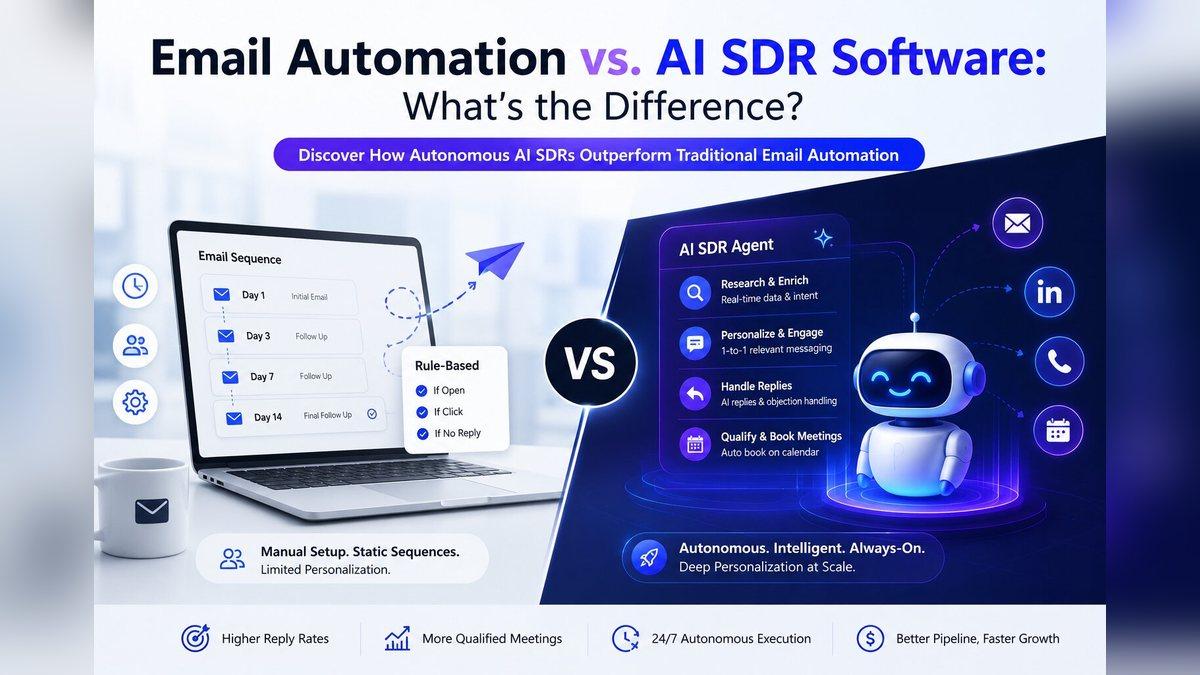
Modern outbound teams keep running into the same wall: the cold cadence that worked two years ago converts a fraction as well today. Traditional email automation solved a real problem — nobody types a hundred emails by hand any more — but it solved the typing, not the thinking. AI SDR software (an Artificial Intelligence Sales Development Representative) is aimed at the thinking: autonomous account research, adaptive messaging, and replies handled without a human in the loop.
The two categories are often sold as though they compete. They mostly do not. Understanding where the line falls is what tells you whether you need a better sequencer or a different kind of tool entirely — and buying the wrong one is expensive in a way that takes a quarter to notice.
What is email automation?
Email automation sends pre-scheduled, rule-based cold email sequences to a list you built. It runs on human setup and static logic: you write the copy, you define the delays, and the tool executes exactly that until something stops it.
That is not a criticism. Deterministic execution is a feature — you know precisely what will be sent, to whom, and when, which matters a great deal when the thing being automated is a message from your company.
- Drip campaigns and sequencing — delivering a fixed series of emails across scheduled intervals, typically Day 1, Day 3, Day 7.
- Merge-tag personalisation — inserting variables such as {{first_name}} or {{company}} from a CSV or CRM record into a static template.
- Rule-based triggers — sending a specific follow-up if a prospect opens an email or clicks a tracked link.
- Deliverability controls — daily send limits, mailbox warmup, and inbox rotation so the volume actually reaches inboxes.
Where email automation stops
A sequencer cannot interpret buyer intent, research an account, or respond when a prospect asks something the template did not anticipate. When a reply arrives, the sequence pauses and waits for a person. That pause is the whole limitation, and it is where the working hours go: triage, research, and writing the one-off response that the template could not cover.
For a low-touch, high-volume motion that is perfectly acceptable. For complex B2B sales it means your throughput is capped by how fast a human can read and reply.
What is AI SDR software?
An AI SDR is an autonomous agent that carries out the end-to-end job of a sales development representative rather than just the sending half of it. Instead of executing a fixed sequence, it analyses intent signals, researches the target account, writes messaging specific to that account, and handles objections on its own.
- Dynamic account research — reading company sites, recent funding, hiring trends and public activity to build a value proposition for that specific business.
- Autonomous reply qualification — classifying an incoming reply as interested, a referral, an out-of-office or an objection, then composing the appropriate response.
- Multi-channel orchestration — coordinating email, social touches and AI voice calls against the same prospect record.
- Meeting booking — qualifying against your ICP and placing the call directly on an account executive's calendar.
The four differences that actually change results
Feature lists blur the distinction. These four are the ones that show up in pipeline.
1. Static execution vs. contextual decisions
Email automation runs an assembly line: it does what the operator wrote, in order. An AI SDR evaluates context. When a prospect replies "I am not the right person — talk to Sarah, our VP of Engineering", a sequencer flags a reply and halts. An AI SDR extracts the referral, finds Sarah's contact details, and opens a new thread that references who sent it. Same inbound message, entirely different outcome.
2. Depth of personalisation
Merge tags produce mail that is obviously templated, because it is. Swapping a company name into an otherwise identical paragraph does not make a message relevant — buyers have been reading that pattern for a decade and discount it on sight. Research-backed outreach that references a real, recent, specific thing about the business is a different category of message, and it is the difference that shows up in reply rates.
3. Where the working hours go
With a sequencer, reps spend a substantial share of every week on list building, copy variants, reply triage and CRM hygiene — work that produces no pipeline by itself but has to happen for the pipeline to exist. Moving that work to software does not make a rep more productive by magic; it moves their hours onto discovery calls and closing, which is the only place a human is genuinely irreplaceable.
4. Single channel vs. orchestrated channels
Email automation lives in the inbox. Some prospects do not answer email and will pick up a phone; some will only respond after they have seen you somewhere else first. Running channels from separate tools means separate lists, separate suppression, and a real risk of calling somebody who replied yesterday. Orchestration means a reply on one channel stops the others, because it is the same prospect record.
Side by side
The short version of everything above:
- Operating logic — automation is static if/then rules; an AI SDR is context-aware and decides per prospect.
- Research — automation needs a list you built and enriched; an AI SDR does its own prospecting and reads live signals.
- Personalisation — automation fills merge tags; an AI SDR writes from what it found about that account.
- Inbound replies — automation pauses and waits for you; an AI SDR interprets, answers, and handles objections.
- Channels — automation is email; an AI SDR runs email, voice and social together.
- What limits scale — automation is capped by human triage time; an AI SDR runs continuously.
Which one should you buy?
This depends on your sales model and average contract value more than on any feature comparison. Both answers are legitimate, and buying the more sophisticated tool for a motion that does not need it is a real way to waste money.
Choose email automation if
- You run high-volume, low-touch, low-ACV sales where volume matters more than relevance.
- You already have a library of templates that convert and a motion that works.
- Your main need is newsletter distribution or straightforward onboarding drips.
- Budget rules it out — a sequencer that you use well beats a platform you do not.
Choose an AI SDR if
- You sell complex B2B at mid-to-high ACV, where one extra meeting pays for the tooling.
- You need more outbound coverage without tripling SDR headcount.
- Your buyers ignore anything that reads as templated.
- You want prospecting and follow-up to continue outside working hours.
The honest summary
Email automation is not obsolete. For broadcast messaging and simple drips it is the right tool, and a well-run sequencer beats a badly configured AI SDR every time.
But for high-growth B2B outbound, the constraint stopped being send volume a while ago. It is relevance, and the human hours spent manufacturing it. That is the specific problem an AI SDR is built for — pairing automated research with real-time conversational handling so a cold list becomes a qualified pipeline without a proportional increase in headcount.
If you want to see what that looks like across email, voice and social in one product, start a free trial or read how we compare to Instantly.